What is the difference between DA and DR?
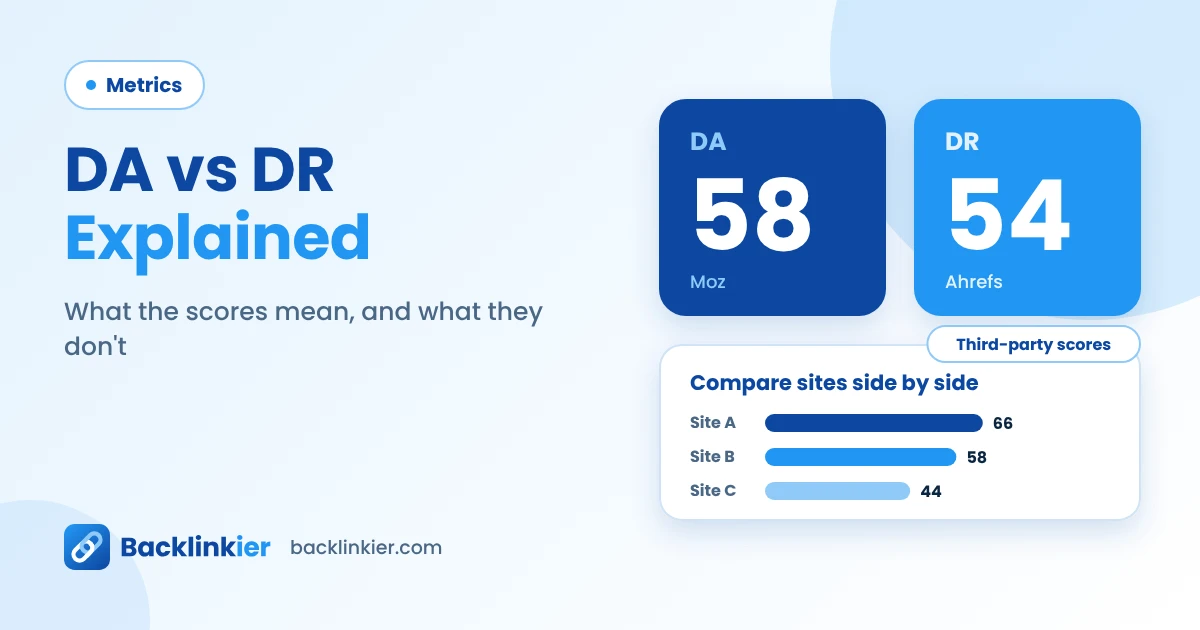
DA (Domain Authority) is Moz's score, and DR (Domain Rating) is Ahrefs' score. Both rate how strong a website's backlink profile looks on a scale of up to 100, but they come from different companies, use different data and often give different numbers for the same site. Neither is a Google metric, and neither tells you how a page will rank.
If you've ever seen a site with a DA of 45 and a DR of 62 and wondered which one is right, the answer is that both are estimates. This guide explains what each number measures, where they fall short, and how to use them without being misled.
What is Domain Authority (DA)?
Domain Authority is a score from 1 to 100 created by Moz. It's described as a ranking score meant to predict how likely a website is to rank in search results. Moz builds it with machine learning, using data from its own link index, including how many sites link to a domain and how strong they are.
Two things are easy to miss:
- It's relative. DA is calculated against other sites in Moz's data. If a large site suddenly gains a lot of links, other sites' scores can drop even though nothing changed on them.
- It's not Google's. Moz states that DA works independently of Google rankings. It's a prediction model, and Google doesn't use it.
In short, DA is a handy comparison number, not a measurement of what Google actually thinks of a site.
What is Domain Rating (DR)?
Domain Rating is Ahrefs' score for the strength of a website's backlink profile, shown on a 100-point scale. It looks at the number and quality of the domains that link to a site. A link from a high-DR domain counts for more, and a site that links out to many places splits its strength between them.
Ahrefs is clear about its limits. DR is calculated at the domain level, so it says nothing about a single page. It is also relative, so Ahrefs notes you can't say that a DR of 30 is good or bad on its own. And it only looks at backlinks. Ahrefs itself says to weigh link quality, content, traffic and relevance too. It adds that DR correlates with Google rankings fairly well, though not as closely as its page-level score, URL Rating.
DA vs DR: how do they compare?
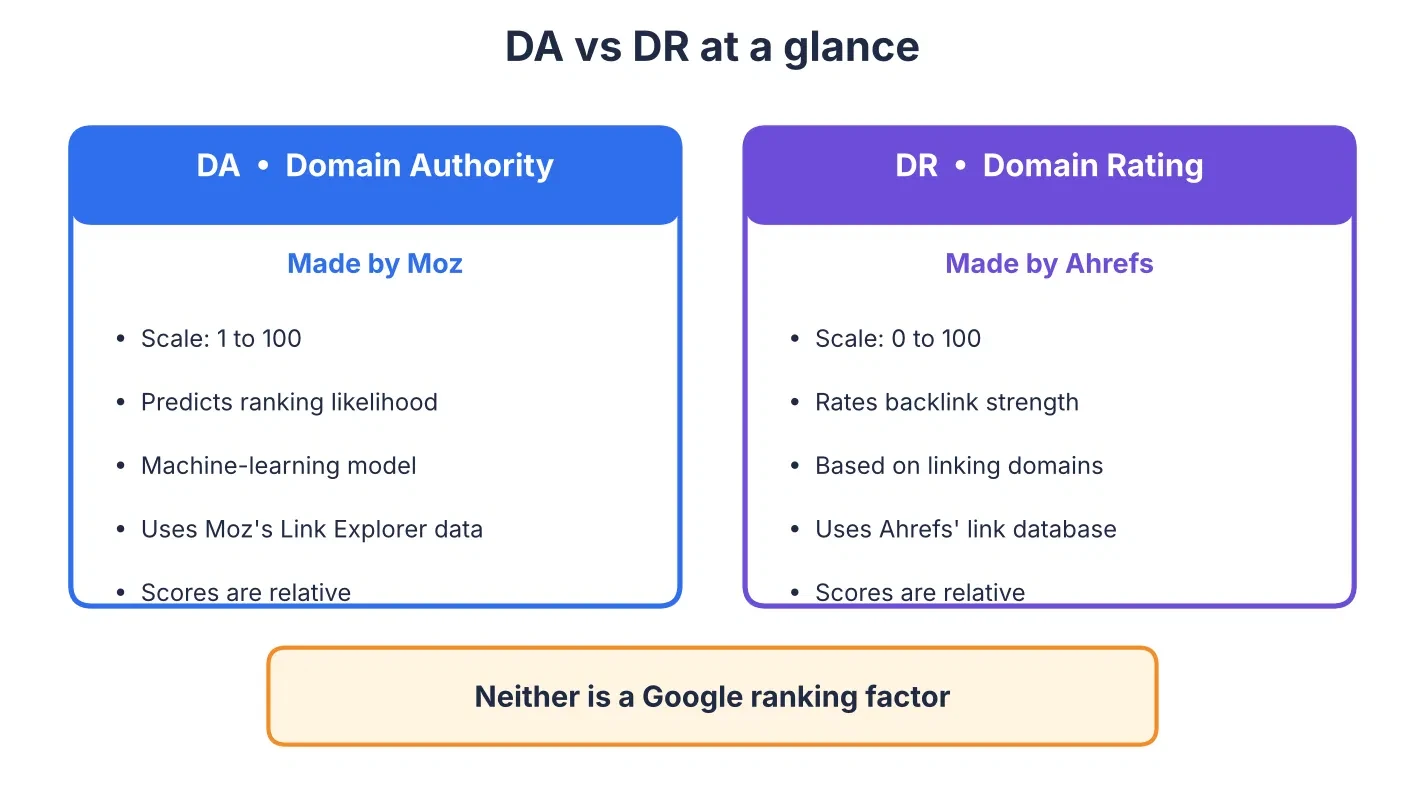
The two scores look alike, but they answer slightly different questions.
|
Question |
DA (Moz) |
DR (Ahrefs) |
|---|---|---|
|
What is it trying to do? |
Predict how likely a domain is to rank |
Show the strength of a domain's backlink profile |
|
How is it built? |
Machine-learning model on Moz link data |
Calculated from linking domains and their own ratings |
|
Does it look at anything besides links? |
Link-based inputs, shaped by ranking predictions |
No, backlinks only |
|
Is it page-level or domain-level? |
Domain-level (Moz also offers Page Authority) |
Domain-level (Ahrefs offers URL Rating for pages) |
|
Can the same site have different scores? |
Yes |
Yes |
|
Is it used by Google? |
No |
No |
Because each tool crawls the web and counts links its own way, the same website can get quite different numbers. Compare scores from the same tool, never across two.
What don't DA and DR tell you?
This is where most mistakes happen. Neither score is Google's, so neither can tell you what Google thinks of a site. Here is what they leave out:
- They aren't ranking factors. Google has no DA or DR. They're outside estimates.
- They say nothing about a single page. A strong domain can host a weak page, and the reverse.
- They ignore relevance. A high score from an unrelated site may add little for you.
- They can't see traffic or content quality. A site can have a big score and little real audience.
- They can be gamed. Low-quality link schemes can inflate a score without making a site any better.
- They move without warning. Scores can shift when a tool updates its model or index, even if your site hasn't changed.
- They don't show risk. A high score doesn't prove a site is safe or free of spam.
So a high DR or DA isn't proof that a link is good, and a low one isn't proof that it's bad. A small, respected niche blog with a modest score can be a far better source than an expired domain with an impressive number.
How should you use DA and DR?
Use them as a first filter and a comparison tool, not as a verdict.
- Stay in one tool. Pick DA or DR and compare like with like.
- Use them to compare, not to judge. They're best for ranking a list of possible link sources or for sizing up competitors.
- Set a rough floor, not a rule. Skipping sites with a near-zero score can save time, but make exceptions for relevant, active niche sites.
- Check the real thing. Open the site. Look for genuine content, a named author, steady publishing and real readers.
- Look at the trend. A score that climbs steadily is healthier than one that jumps overnight.
- Add other signals. Estimated organic traffic, topical relevance and the placement of the link matter at least as much.
- Be wary of sellers who sell by score. If a vendor promises "DR 70+ links" and nothing else, ask about relevance, traffic and how the sites were chosen.
For a fuller process, see our guide to checking whether a backlink is high quality.
Can you increase your DA and DR?
Yes, but treat the score as a result, not a target. Both tools count backlinks from other websites, so your score generally rises when more trusted, relevant sites link to you.
The approaches that work are the same ones that help real rankings:
- Publish content worth linking to, such as original research, useful tools and clear guides.
- Earn links from relevant, reputable sites through digital PR, guest contributions and partnerships.
- Fix broken links and reclaim mentions of your brand.
- Be patient. Scores usually move slowly, and they can dip when the tool recalculates.
And a warning. Buying bulk links, using private blog networks or chasing numbers for their own sake can lift a score while putting your site at risk. Google's spam policies treat link schemes as violations, so a higher number isn't worth a penalty.
Do DA and DR matter for AI search?
Not directly. AI answer tools such as Google's AI Overviews, ChatGPT search and Perplexity don't publish a rule that says "cite sites with a high DA." What they appear to favor are pages that are useful, current and come from trustworthy sources, though nobody outside those companies knows the exact method.
That shifts what's worth your attention:
- Real expertise. Named authors, credentials and first-hand knowledge.
- Clear, quotable answers. A direct answer near the top of the page.
- Consistent brand mentions on respected sites across the web.
- Fresh, sourced facts that others can cite.
DA and DR can still be a quick way to size up the link sources behind those mentions. Just remember they describe a site's link profile, not whether its content deserves to be trusted or cited.
DA vs DR FAQ
What does DA stand for in SEO?
DA stands for Domain Authority, a score from 1 to 100 created by Moz that estimates how likely a website is to rank in search results.
What does DR stand for in SEO?
DR stands for Domain Rating, a score from Ahrefs that shows the strength of a website's backlink profile on a 100-point scale.
Which is better, DA or DR?
Neither is better. They use different data and models. Pick one, use it consistently, and don't treat either as a verdict on a site's quality.
Does Google use DA or DR?
No. Both are third-party metrics. Google doesn't use them as ranking factors.
What is a good DA or DR score?
There's no universal answer. Scores are relative, so a good number depends on your niche and competitors. Compare against sites you're actually competing with.
Why is my DA different from my DR?
They come from different companies with separate link databases and formulas, so the same site can score quite differently in each.
Final thoughts
DA and DR are useful shortcuts, not scorecards from Google. Use one of them to compare sites quickly, then judge the link itself: relevance, real readers, natural placement and trust.
If you take one habit from this guide, make it this: before you chase or buy a link because of its score, open the site and ask whether you'd be proud to be mentioned there.