What is a backlink?
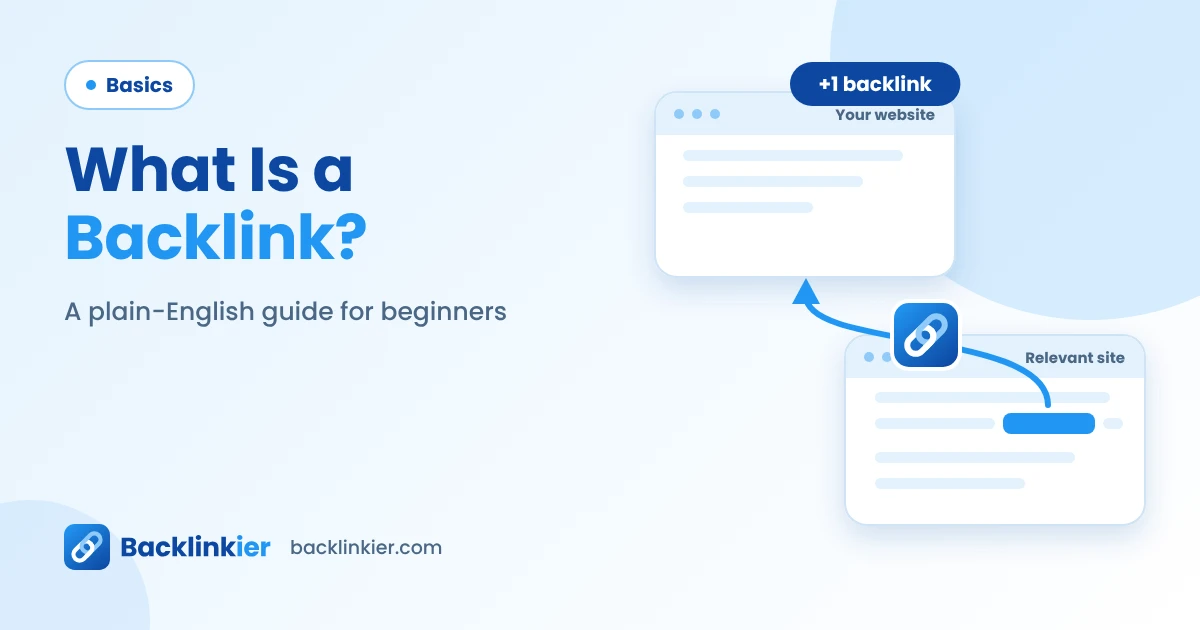
A backlink is a link from one website to another. When a page on a site you don't own links to a page on yours, that link is a backlink to you. You will also hear them called inbound links or incoming links. Search engines read them as votes of confidence, which is why backlinks are still one of the most talked-about factors in SEO.
Here is the everyday version. Imagine you open a new bakery. If a stranger tells their friends your sourdough is worth the drive, that carries more weight than anything you say about yourself. A backlink is the web's version of that recommendation. Someone else, with their own audience and reputation, points to you and says, "This is worth a look."
In this guide we'll cover how backlinks work, why they matter, which kinds are worth having, how to earn them without cutting corners, and how they fit into a world where people increasingly get answers from AI tools.
How does a backlink work?
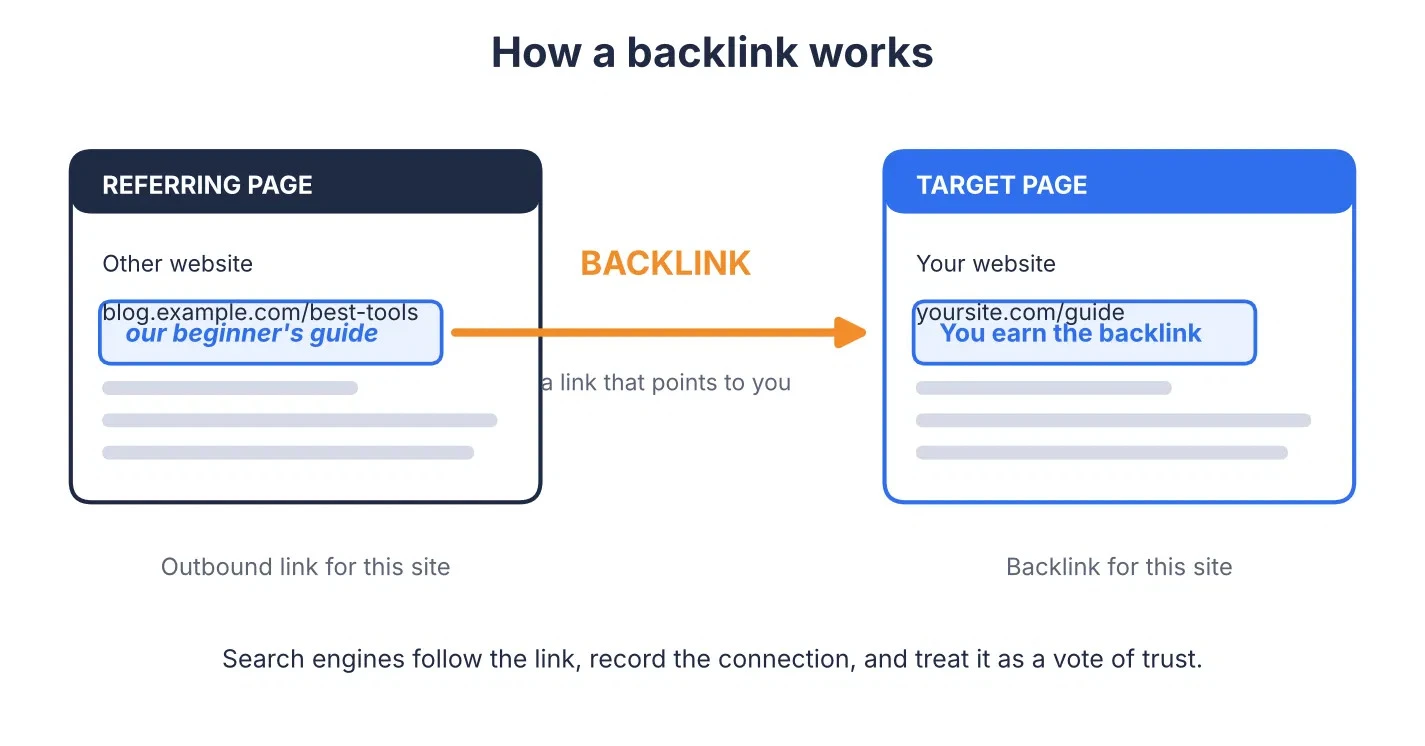
Every backlink has the same basic parts. There is the referring page, which is the page that holds the link, and the target page, which is where the link points. In between sits the anchor text, the clickable words a reader sees. Behind the scenes, an HTML tag ties it all together:
our beginner's guideWhen a search engine crawls the referring page, it follows that link, finds your page, and records the connection. Do that across billions of pages and you get a map of who links to whom. Google built its original ranking system, PageRank, on exactly this idea: a page that many trusted pages link to is probably worth showing.
Two things are worth remembering. First, a backlink is always seen from the receiving side. The same link is an outbound link for the site that placed it and a backlink for the site that got it. Second, the link does two jobs at once. It helps search engines discover and judge your page, and it sends real people there too.
Why do backlinks matter for SEO?
Backlinks matter because they help search engines answer a hard question: which pages can be trusted? Content alone can't prove that. Other people vouching for it can.
Here is what a good backlink does for you:
- Builds authority. Links from respected, relevant sites signal that your content is credible.
- Helps pages get found. Crawlers move from link to link, so a new page with a few good links gets discovered faster than one that sits alone.
- Supports rankings. Google has said for years that links remain one of the many signals it uses, although no one outside the company knows the exact weight.
- Sends referral traffic. A link in a well-read article brings visitors who are already interested in the topic.
- Builds brand recognition. Being mentioned and linked on respected sites puts your name in front of new audiences.
One honest caveat: backlinks are not a magic switch. A page with great links and weak content won't hold its position for long, and great content with no links can stay invisible. The two work as a pair.
What are the different types of backlinks?
Not every link is built the same way. The type depends on how the link was placed and what tag, if any, sits on it. Most links carry no special tag at all and are treated as ordinary links that can pass credibility.
|
Type |
HTML attribute |
What it signals |
Typical example |
|---|---|---|---|
|
Editorial link |
None |
A site chose to link to you because your content was useful |
A journalist cites your study |
|
Nofollow link |
|
The linking site doesn't want to vouch for the page |
A link in a forum signature |
|
Sponsored link |
|
The link was paid for or part of an ad deal |
A paid partnership or advertorial |
|
UGC link |
|
The link was added by a user, not the site owner |
A blog comment or forum post |
Google introduced the sponsored and UGC labels in 2019. Since March 2020 it treats all three labels as hints, not strict commands, so a nofollow link can still be noticed. That said, editorial links are the ones worth chasing, because someone chose to give them without being asked or paid.
A mixed profile is normal and healthy. A site with only perfect editorial links would look odd. Real sites collect all sorts of links over time.
What makes a backlink good (or bad)?
The number of links pointing at you tells you very little. Quality decides almost everything. One link from a respected publication in your field can be worth more than a hundred from sites nobody reads.
A strong backlink usually has these traits:
- Relevance. The linking site covers a topic close to yours. A cycling blog linking to a bike repair guide makes sense.
- Authority and trust. The site is established, well edited, and has a real audience.
- Natural context. The link sits inside useful content, not in a footer or a list of unrelated links.
- Descriptive anchor text. The words tell the reader what they'll find, without being stuffed with keywords.
- Editorial choice. Someone linked because they wanted to, not because they were paid or traded favors.
And these are warning signs:
- Links from sites with no real content or audience
- Paid links with no sponsored label
- Large-scale link swaps between sites
- Sudden spikes of links with identical anchor text
- Links from pages in unrelated languages or topics
Google's spam policies treat link schemes, meaning links created mainly to manipulate rankings, as a violation. The penalty can range from ignored links to a drop in visibility, so cutting corners rarely pays.
How do you get backlinks the right way?
The short answer: make something worth linking to, then make sure the right people know it exists. There is no shortcut that lasts, but there are methods that work.
- Publish original research or data. Surveys, benchmarks and first-hand findings give writers something they can't get elsewhere, and they cite what they use.
- Create genuinely useful resources. Clear guides, free templates, checklists and calculators earn links because people want to share them.
- Write guest posts for relevant sites. Pick publications your audience reads and offer something useful, not a thinly veiled ad.
- Do digital PR. Pitch journalists a real story or an expert comment. A single mention in a trade publication can bring a lasting link.
- Fix broken links. Find pages that link to content that no longer exists, then politely suggest your relevant page as a replacement.
- Reclaim unlinked mentions. If a site mentions your brand without linking, a friendly note often turns the mention into a link.
- Share what you make. Promote new work through email, social channels and communities, so the people who might link actually see it.
When you reach out, be a person. Short, specific messages that explain why your page helps their readers get far better replies than copy-paste templates. And skip anything that promises hundreds of links for a flat fee. That is the quickest way to land in trouble.
Do backlinks still matter in the age of AI search?
Yes, though the picture is shifting. More people now get answers from AI summaries and chat tools such as Google's AI Overviews, ChatGPT search and Perplexity, and those tools often cite web pages as sources. The companies behind them don't publish exactly how they pick what to cite, so nobody can claim a formula. What we can say is that the signals behind good backlinks, trust, relevance and reputation, tend to be the same signals that make a source worth citing.
If you want to be found by both search engines and AI tools, a few habits help:
- Be easy to quote. Open each section with a clear, direct answer, as this guide does with its definition.
- Earn mentions, not only links. Being named across respected sites builds a reputation that machines and people both notice.
- Stay consistent. Use the same brand name, author names and descriptions everywhere.
- Show real expertise. Name the author, show their credentials, and back claims with sources.
- Keep content fresh and structured. Descriptive headings, short paragraphs and updated facts make a page easier to read, for people and for software.
Think of backlinks as one part of a bigger goal: becoming a source other people, and increasingly other systems, trust enough to point to.
How can you check your backlinks?
The easiest place to start is free. In Google Search Console, open the Links report. It shows which sites link to you, which of your pages get the most links, and the anchor text people use.
For a wider view, SEO tools such as Ahrefs, Semrush and Moz keep their own link indexes and let you look at competitors too. Each tool crawls the web differently, so numbers will not match exactly between them. Use them to spot trends and opportunities, not to chase a single score.
When you review your list, ask three simple questions. Are these sites relevant to what I do? Do they look like real sites with real readers? And did anything appear suddenly that I didn't expect? Anything that looks like spam is worth a closer look.
What backlink mistakes should you avoid?
Most backlink trouble comes from impatience. These are the slip-ups that show up again and again:
- Buying links in bulk. Cheap packages usually deliver low-quality links that do little good and can cause harm.
- Chasing quantity. Ten relevant links beat a thousand random ones.
- Over-optimizing anchor text. If every link uses the same exact phrase, it looks planned. Natural links use varied wording.
- Ignoring your own site. Links can't rescue slow, thin or confusing pages. Fix the content first.
- Skipping the relationship. Outreach works best when you've paid attention to the person and their site.
- Never checking. A quick review every few months catches spammy links and lost ones early.
If you do find harmful links you didn't create, don't panic. Google says it generally ignores spammy links, and the disavow tool is meant for rare, serious cases, such as a manual action or a large-scale link scheme you can't undo.
Backlink FAQ
What is a backlink in simple words?
A backlink is a link on someone else's website that points to your website. Search engines treat it as a sign that your page is worth visiting.
Are backlinks still important for SEO?
Yes. Links remain one of the signals search engines use to judge trust and relevance, but they work alongside content quality, page experience and search intent, not instead of them.
What is the difference between a backlink and an internal link?
A backlink comes from a different website. An internal link connects two pages on the same site. Both help search engines understand your content, but only backlinks bring outside endorsement.
How many backlinks do I need?
There is no magic number. What counts is quality and relevance. A page competing for an easy topic may need very few, while a hard topic may need many strong ones.
Is a nofollow backlink worthless?
No. It may pass less ranking credit, but it can still send visitors, build awareness and lead to other links. Google treats nofollow as a hint, so it can still be considered.
How long does it take for backlinks to help rankings?
It varies. New links must be found and processed first, and rankings also depend on competition and content. Expect weeks to months, not days.
Final thoughts
A backlink is one site saying to its readers, "go here, this is good." Collect enough of those from places people trust, and search engines and AI tools alike have good reason to trust you too.
So start small. Make one page that's truly worth citing, share it with the people who'd care, and check your Links report in Search Console next month. Earning backlinks is slow work, but done honestly, it keeps paying off long after the effort is over.