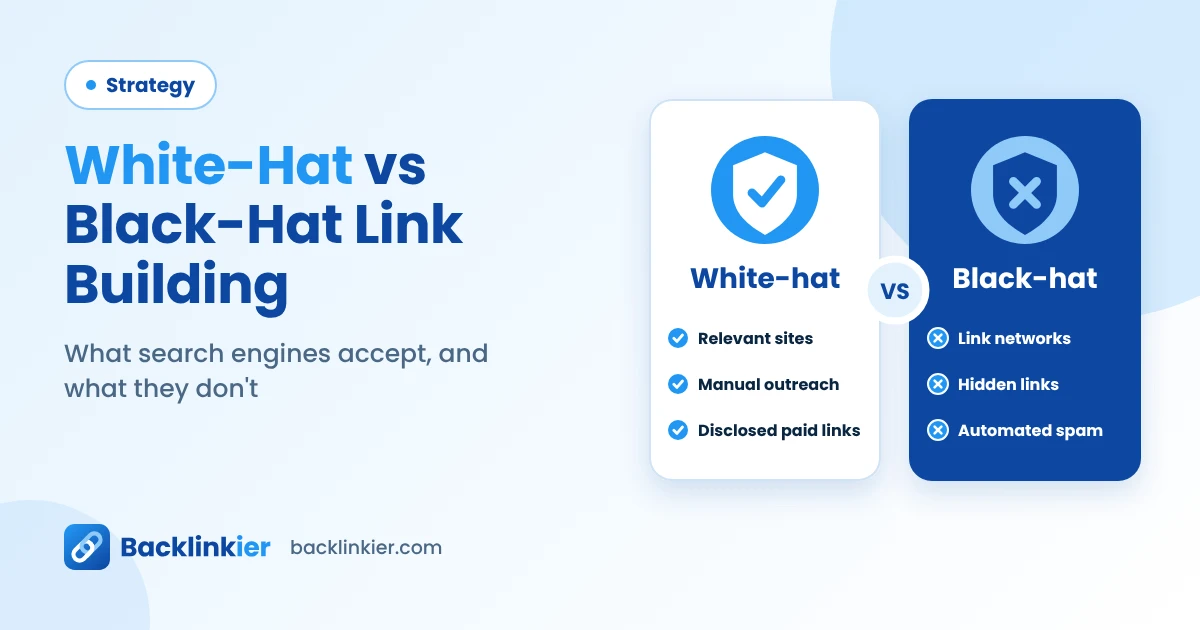
White-hat link building is the safe route. It earns links by creating content and relationships that people genuinely want to point to, and it follows Google's guidelines. Black-hat link building uses tricks such as paid link networks, hacked sites and automated spam to fake popularity. It can bring fast gains, but it also brings penalties, lost rankings and a lot of cleanup. Grey-hat sits in between, and that's where most of the real decisions are made.
If you've ever been offered "500 high-quality backlinks for $50," you already know the temptation. This guide explains what separates the safe methods from the risky ones, how to judge the grey areas, and how to build links you won't regret in a year.
What is link building, and why does the method matter?
Link building is the work of getting other websites to link to yours. Those links, called backlinks, are one of the signals search engines use to judge whether a page is trustworthy and relevant.
That's why people try so hard to get them, and also why people try to cheat. The terms "white hat" and "black hat" come from old Western films, where the good guy wore a white hat and the villain wore a black one. In SEO, the label describes one thing: whether you play by the search engine's rules.
The method matters because search engines are built to reward links that were earned, not manufactured. When your links are real, they hold up over time. When they're not, you're building on sand.
What is white-hat link building?
White-hat link building means earning links in ways that follow search engine guidelines and put the reader first. The links come because your page is useful, original or newsworthy, not because you tricked anyone.
These are the methods that hold up:
- Original research and data. A survey, a benchmark or a study gives writers something new to cite.
- Genuinely useful resources. Free tools, templates, checklists and in-depth guides get shared because they save people time.
- Digital PR. Pitching a real story or expert comment to journalists can earn links from respected publications.
- Broken link replacement. You tell a site owner that a link on their page is dead and suggest a working, relevant alternative.
- Unlinked brand mentions. If someone mentions you without linking, a friendly request often fixes it.
- Real partnerships and community involvement. Sponsoring a local event, contributing expert quotes or joining an industry group naturally leads to links.
The trade-off is time. White-hat links usually build slowly, and results can take months. In return, they tend to keep working and don't put your site at risk.
What is black-hat link building?
Black-hat link building is any attempt to create links that break search engine guidelines, usually to manipulate rankings rather than to help readers. Google calls these "link spam," and it sits inside its documented spam policies.
Here are the usual suspects:
- Private blog networks (PBNs). Groups of sites built only to link to your site.
- Buying links to pass ranking credit. Paying for links without the proper
rel="sponsored"label. - Automated link spam. Software that drops links into blog comments, forums and profiles by the thousand.
- Hacked-site links. Injecting links into sites you don't own.
- Hidden links. Links tucked away in white-on-white text or tiny fonts.
- Large-scale link exchanges. "Link to me and I'll link to you" done in bulk.
- Fake profiles and reviews. Invented accounts that exist only to drop links.
Why do people still do it? Because it can work, for a while. That's the catch. Search engines keep improving at spotting patterns, and a link scheme that worked last year can become a liability overnight. The savings you make on effort come back as repair costs.
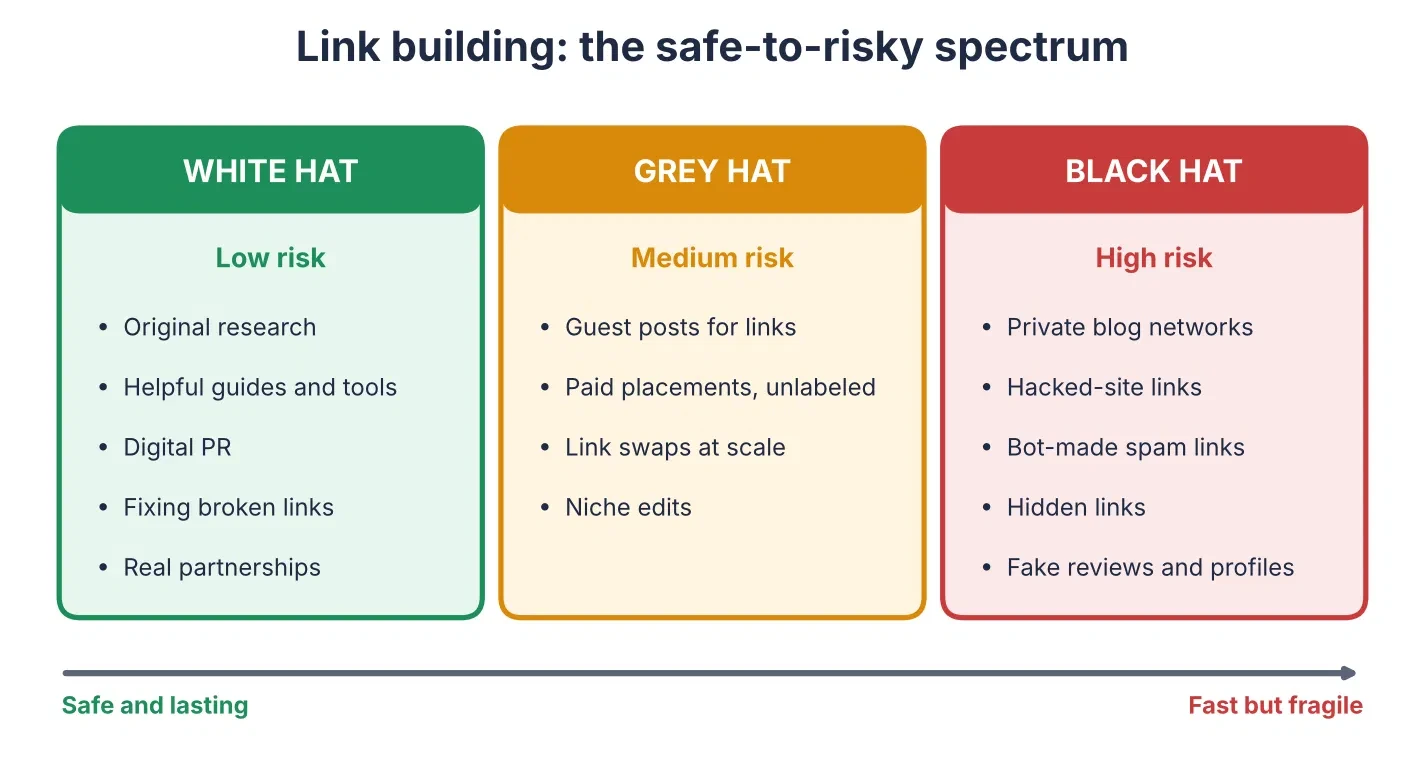
White hat vs grey hat vs black hat at a glance
|
Factor |
White hat |
Grey hat |
Black hat |
|---|---|---|---|
|
Follows search guidelines |
Yes |
Partly |
No |
|
Risk of penalty |
Low |
Medium |
High |
|
Speed of results |
Slow |
Moderate |
Fast at first |
|
Lasting value |
High |
Uncertain |
Often short-lived |
|
Cost over time |
Steady effort |
Varies |
Cheap now, costly later |
|
Typical example |
Original study cited by a news site |
Paid guest post with followed link |
Private blog network |
What about the grey area?
Most real-world questions aren't clear-cut. Grey-hat tactics aren't openly banned, but they sit close to the line, and the outcome depends on how you do them.
- Guest posting. Writing a useful article for a relevant site is fine. Mass-producing thin guest posts with keyword-stuffed links is not. Google has warned against large-scale guest posting campaigns built mainly for links.
- Paid placements and sponsorships. Paying for exposure isn't wrong. Paying for a link that passes ranking credit, without a
rel="sponsored"ornofollowlabel, is. - Link exchanges. A one-off mention between two real partners is natural. Systematic "you link to me, I link to you" swaps are a link scheme.
- Niche edits. Asking an owner to add a link to an existing article can be harmless, but paying for it in bulk starts to look like buying links.
A simple test helps: would you still want this link if search engines didn't exist? If the placement would send real visitors, make sense to a reader and survive a manual review, you're probably fine. If it only makes sense because of rankings, treat it as risky.
What does Google say, and what do penalties look like?
Google's spam policies list "link spam" as a violation. That includes buying or selling links that pass ranking credit, excessive link exchanges, automated link creation and requiring a link as part of terms of use. Google also asks site owners to label paid and user-generated links with rel="sponsored" and rel="ugc".
There are two ways problems show up:
- Algorithmic action. Google's automated systems, including its spam detection system SpamBrain, can simply ignore links they judge to be manipulative. You may never get a message. Your rankings just stop improving or slide.
- Manual action. A human reviewer can apply a penalty to your site or pages. If that happens, a notice appears in the Manual Actions report in Google Search Console, and you'll need to clean up and submit a reconsideration request.
Recovery isn't quick. You may need to remove or disavow bad links, document your efforts and wait for review. Even then, the rankings you lost don't always come back to where they were.
To be fair, a few spammy links pointing at you don't doom a site. Google has said it's good at ignoring junk links. The danger comes from patterns: links that you built or paid for, at scale, to manipulate ranking.
Does link quality matter for AI search too?
It does. People now get answers from AI summaries and chat tools such as Google's AI Overviews, ChatGPT search and Perplexity, and those tools often cite sources. Nobody outside these companies knows exactly how they choose, so be wary of anyone who sells a guaranteed formula.
What's reasonable to say is this. AI tools lean on search indexes and on signals of trust and reputation. Sites built on spam links tend to look low quality, and low-quality sites are poor candidates to be cited or recommended. Real mentions on respected sites do the opposite: they make your brand easier to recognize and trust.
That's why the safe approach also fits the AI era:
- Earn mentions from relevant, reputable sources, not from link farms.
- Keep your brand and author details consistent across the web.
- Publish original, quotable facts that others want to reference.
- Answer questions clearly, with a direct answer up top, as this guide does.
Shortcuts built for one algorithm rarely survive the next one.
A safety checklist before you build or buy any link
Run every opportunity through these questions. A "no" on any of them is a reason to pause.
- Is the linking site relevant to my topic and audience?
- Does it have real content, real readers and editorial standards?
- Would real people click this link and find it useful?
- Is the link placed naturally inside helpful content?
- If money changed hands, is the link labeled
sponsored? - Is the anchor text natural, not a repeated exact-match keyword?
- Am I building links at a pace that looks natural?
- Would I be comfortable explaining this tactic to a Google reviewer?
When hiring an agency, ask them to name the sites they'll try for, and how. Be cautious of anyone who guarantees a number of links, promises results in days, or won't explain their method.
White-hat vs black-hat link building FAQ
What is the difference between white-hat and black-hat link building?
White-hat link building earns links through useful content and genuine outreach, following search engine guidelines. Black-hat link building uses manipulative tactics like link networks, paid links and spam to fake authority.
Is black-hat link building illegal?
Usually it isn't illegal, but it breaks search engine rules. Hacking sites to place links is a different matter and can be a crime.
Is buying backlinks safe?
It's risky. Google's spam policies treat buying links that pass ranking credit as a violation. If you pay for a placement, label it rel="sponsored".
Is guest posting white hat?
It can be, when you write something useful for a relevant site. It becomes risky when it's done at scale for the sake of keyword-rich links.
Can bad backlinks hurt my site?
A handful of random spammy links rarely does, because Google tends to ignore them. A pattern of links you built or bought to manipulate rankings can lead to lost visibility or a manual action.
How do I recover from a link penalty?
Check Search Console's Manual Actions report, remove or disavow the manipulative links, document what you did and submit a reconsideration request.
Final thoughts: build links you can stand behind
The safe answer is white hat, with careful judgment in the grey zone and no black-hat shortcuts. Links earned through useful work last longer, carry less risk and support your brand beyond search.
Before your next outreach email or link purchase, ask one question: would this link exist if I weren't trying to rank? If the answer is yes, keep going.