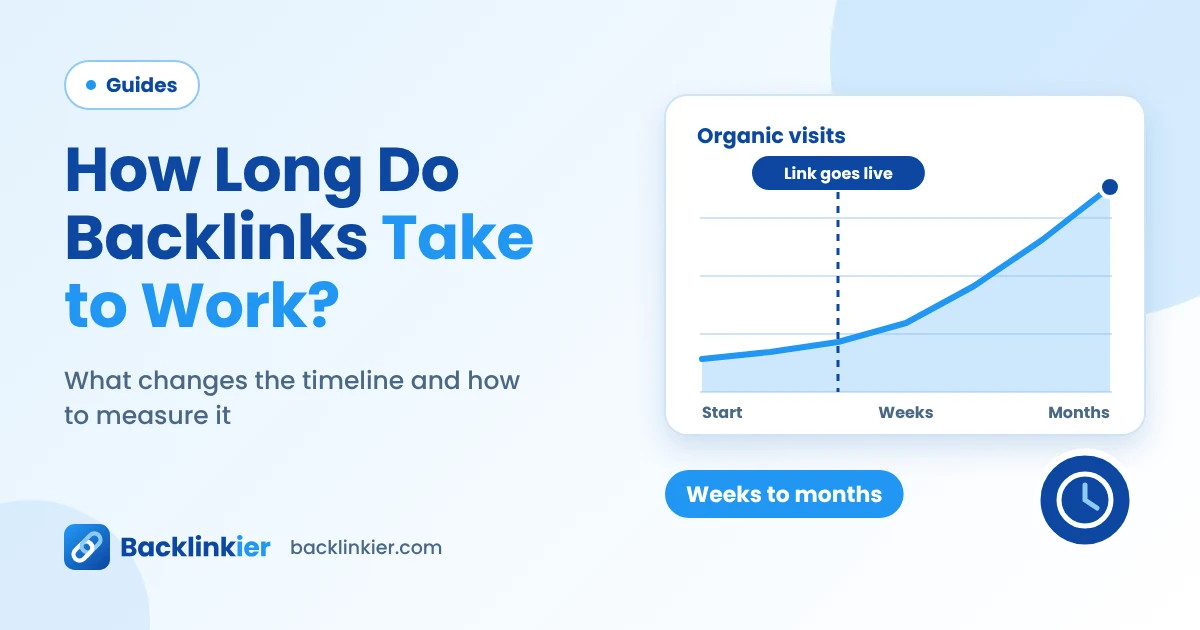
Most backlinks take about one to three months to show an effect on rankings, and competitive keywords can take six months or longer. A new link is often found by Google within days, but ranking changes depend on how strong the link is, how tough the competition is and the quality of your page. There is no fixed number, and anyone who promises one is guessing.
If you've just earned your first good link and nothing has moved after a week, relax. That's normal. This guide walks through what happens behind the scenes, a realistic timeline, why some links seem to do nothing, and how to speed things up without risking a penalty.
What happens between a link going live and a ranking change?
A backlink doesn't count the moment someone publishes it. It passes through a few steps first:
- Discovery. Google has to crawl the page that holds the link. On a busy news site that can happen within hours. On a small, rarely updated blog it can take weeks.
- Indexing. Google has to store that page. If the linking page isn't indexed, the link may not count at all.
- Evaluation. Google's systems judge the link in context: how relevant the linking page is, how trusted the site is, and whether the link looks natural.
- Ranking update. Only after that can the link influence how your page ranks, alongside hundreds of other signals.
Google's own guidance is honest about this. Its SEO starter guide says changes may take effect in a few hours, while others could take several months, and it suggests waiting a few weeks before judging results. Backlinks follow the same pattern.
What is a realistic backlink timeline?
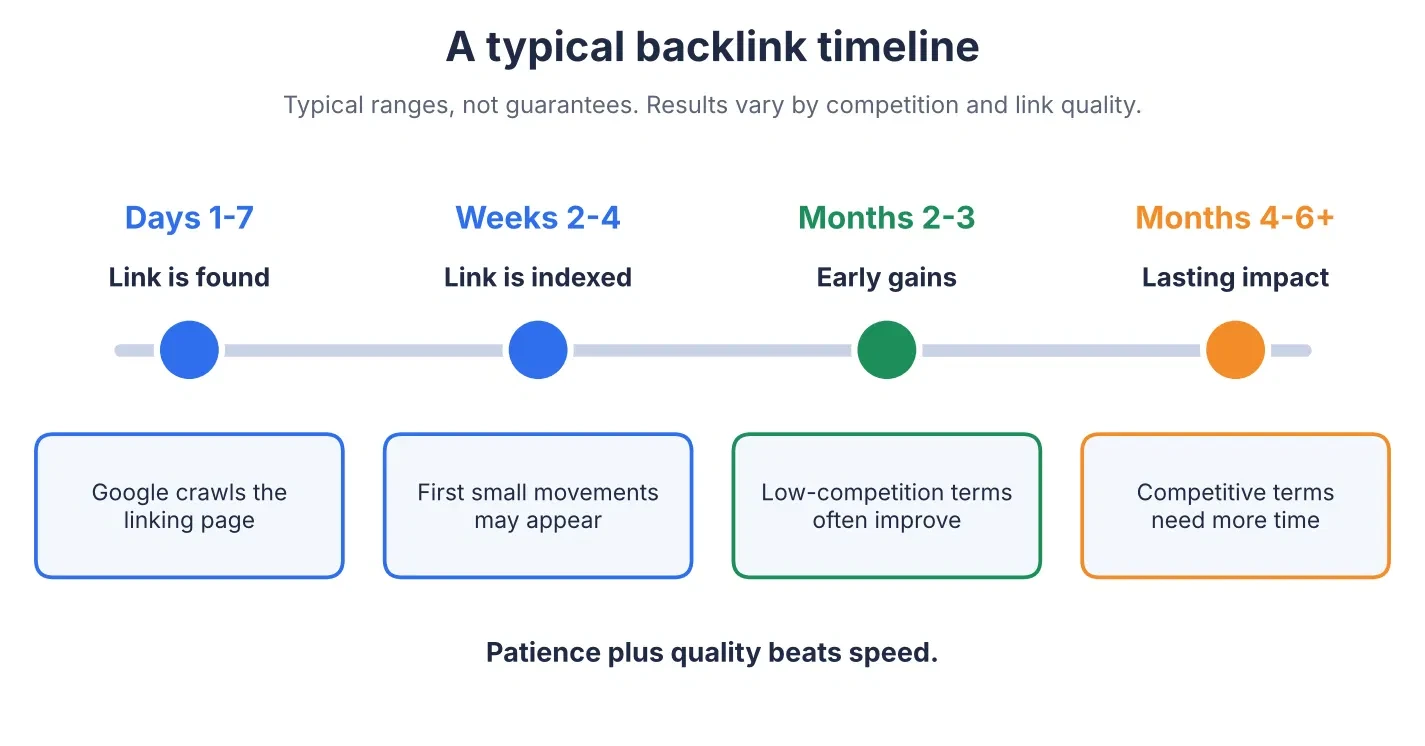
The timeline above is a rough guide drawn from common industry experience, not a promise. Google doesn't publish a schedule, and studies from SEO tools differ. How long you wait depends a lot on your situation:
|
Your situation |
Likely wait for visible movement |
|---|---|
|
Low-competition, long-tail keyword with a strong link |
A few weeks |
|
Moderate competition, solid content, a few quality links |
2 to 4 months |
|
High competition, new or small site |
6 months or more |
|
Link from a page Google rarely crawls |
Slower, since discovery itself is delayed |
|
Spammy or irrelevant link |
May never help |
Backlinks also work in a compounding way. The first few links often show little, and the benefit grows as your site earns more links and trust over time.
What affects how fast backlinks work?
Two people can earn the same link and see very different results. These are the main reasons:
- Keyword competition. Ranking for a rare, specific phrase is far quicker than ranking for a term dozens of strong sites are chasing.
- Link quality. One link from a respected, relevant site can outweigh many weak ones.
- Your starting position. A page already ranking on page two needs less of a push than one that isn't ranking at all.
- Content quality. A link can't fix a thin or off-topic page. The page still has to answer the search well.
- Site age and authority. Established sites with a history of trust tend to see movement sooner.
- How the link is placed. A link inside a relevant paragraph is stronger than one in a footer or a long list of links.
- Crawl frequency of the linking site. If Google visits that site often, your link is seen sooner.
- Link velocity and pattern. A steady, natural pace looks real. A sudden burst can look manipulated.
Why haven't my backlinks improved my rankings?
If months have passed with no change, one of these is usually the reason:
- The link isn't indexed. If Google hasn't processed the linking page, it can't count the link.
- The link is nofollow or low value. It may bring visitors but pass little ranking credit.
- The site isn't relevant. A link from an unrelated topic carries less weight.
- Your page doesn't match search intent. If the page doesn't answer what searchers want, links won't rescue it.
- Competitors are stronger. Others may simply have more and better links and content.
- Other problems hold the page back. Technical errors, slow loading or thin content can cancel out the benefit.
- The link was removed or changed. Pages get edited, and links disappear. Check that it's still live.
Before blaming the link, check these basics first. Then look at the quality of the page that received it.
How can you speed up the results safely?
You can't force Google to move faster, but you can remove the delays you control.
- Make sure the page is worth ranking. Match the search intent, answer the question clearly and keep it up to date.
- Aim for links from sites that get crawled often. Active, well-known publications are discovered quickly.
- Link internally. Point your own relevant pages to the page that earned the backlink so authority flows through your site.
- Request indexing where it helps. In Search Console, the URL Inspection tool lets you ask Google to crawl a page. It doesn't guarantee faster ranking.
- Keep earning links steadily. Consistent, natural growth beats a one-time burst.
- Avoid shortcuts. Paid link schemes and spam may give a short-lived bump, but they risk penalties that cost far more time than they save.
If you want a deeper look at the safe versus risky approaches, see the companion guide on white-hat versus black-hat link building.
How do you track whether backlinks are working?
Track the right signals, and give them time. Checking rankings daily will only make you anxious, because positions fluctuate normally.
- Confirm the link exists. Use the Links report in Google Search Console, or a backlink tool, to see that the link is live.
- Watch impressions and clicks. In the Search Console Performance report, filter by the target page and compare periods before and after the link.
- Track average position for target keywords. Look at weekly or monthly trends, not single days.
- Check referral traffic. Your analytics will show visitors arriving from the linking page.
- Note the date. Write down when each link went live so you can compare fairly.
Give it at least four to eight weeks before judging a single link, in line with Google's advice to wait a few weeks after a change.
Do backlinks affect AI search visibility, and how fast?
Possibly, but there's no reliable timeline. AI answers in tools such as Google's AI Overviews, ChatGPT search and Perplexity often draw on pages that already do well in search and come from trusted sources. The companies don't publish how they choose, so treat any exact promise with suspicion.
What you can reasonably expect: once a link helps a page rank better in traditional search, that page becomes a more likely candidate to be surfaced or cited. Mentions on respected sites can also strengthen your brand's reputation over time, which may help in both worlds.
To support this:
- Lead with a clear, direct answer to the question your page targets.
- Keep facts current and cite sources.
- Use the same brand and author names everywhere you appear.
- Earn mentions from relevant, reputable sites rather than chasing volume.
The common thread is trust, and trust builds slowly.
Backlink timing FAQ
How long does it take for a backlink to be indexed?
From a few hours to several weeks. It depends on how often Google crawls the linking page. Links on large, frequently updated sites are usually found faster.
How many backlinks do I need to rank?
There's no set number. A page with an easy keyword may need very few, while a competitive term may need many strong links. Compare against the pages already ranking.
Can backlinks work immediately?
Rarely. A link may be discovered quickly, but visible ranking changes usually take weeks or months.
Why did my rankings drop after getting backlinks?
Rankings move for many reasons, including updates and competitor changes. If the drop follows a burst of low-quality or paid links, review them. Otherwise, look for other causes first.
Do nofollow links help rankings?
They may pass less credit, but Google treats nofollow as a hint. They can still send traffic and lead to other links.
Do backlinks expire?
Not on their own, but they can vanish if the page is changed or removed. The value of an older link can also shift as the web changes, so keep an eye on important ones.
Final thoughts
Expect weeks for a link to be found and months for it to matter, longer in competitive niches. The faster route is a quality page, relevant links and steady effort, not shortcuts.
So pick one page, earn a few links that make sense for your readers, note the dates, and check back in two months. Patience isn't passive here. It's how the results compound.