What is a dofollow backlink?
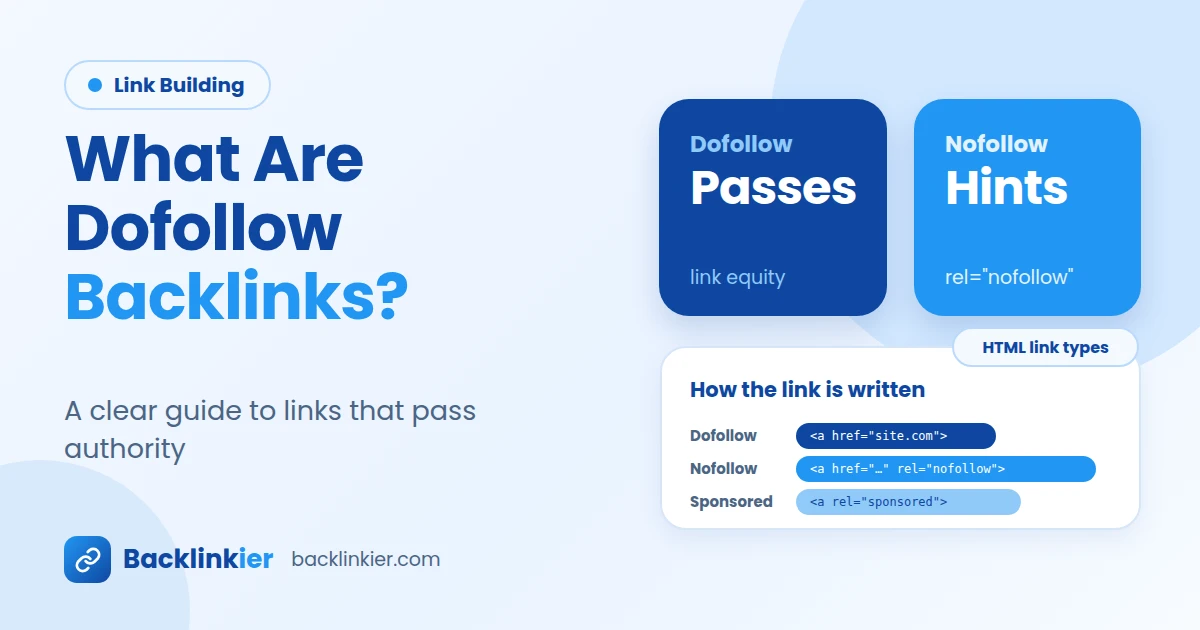
A dofollow backlink is a link from another website that search engines are free to follow and count as a signal when they judge your page. It carries no special tag. Any normal link is dofollow by default, which is why "dofollow" is really just a casual name for a link that has not been marked nofollow, sponsored or UGC.
That small detail trips up a lot of beginners. You'll see people hunting for a "dofollow tag" or a rel="dofollow" setting, and neither exists. In this guide, we'll clear up how dofollow links really work, how they differ from other link types, why they matter, and how to earn them honestly.
How do dofollow links actually work?
Every link on the web is made with an HTML anchor tag. A plain one looks like this:
our beginner's guideThat's a dofollow link. There's nothing extra in it, and that's the whole point. Search engines read it, follow it to the page it points to, and may use it as one of many signals when working out how relevant and trustworthy that page is.
A site owner who doesn't want to vouch for a link adds a label to the tag. Google recognizes three: rel="nofollow", rel="sponsored" and rel="ugc". Take those away and you're left with what people call a dofollow link.
So when someone says they "got a dofollow backlink," they mean one thing: a link from another site, with none of those labels on it.
Dofollow vs nofollow, sponsored and UGC: what's the difference?
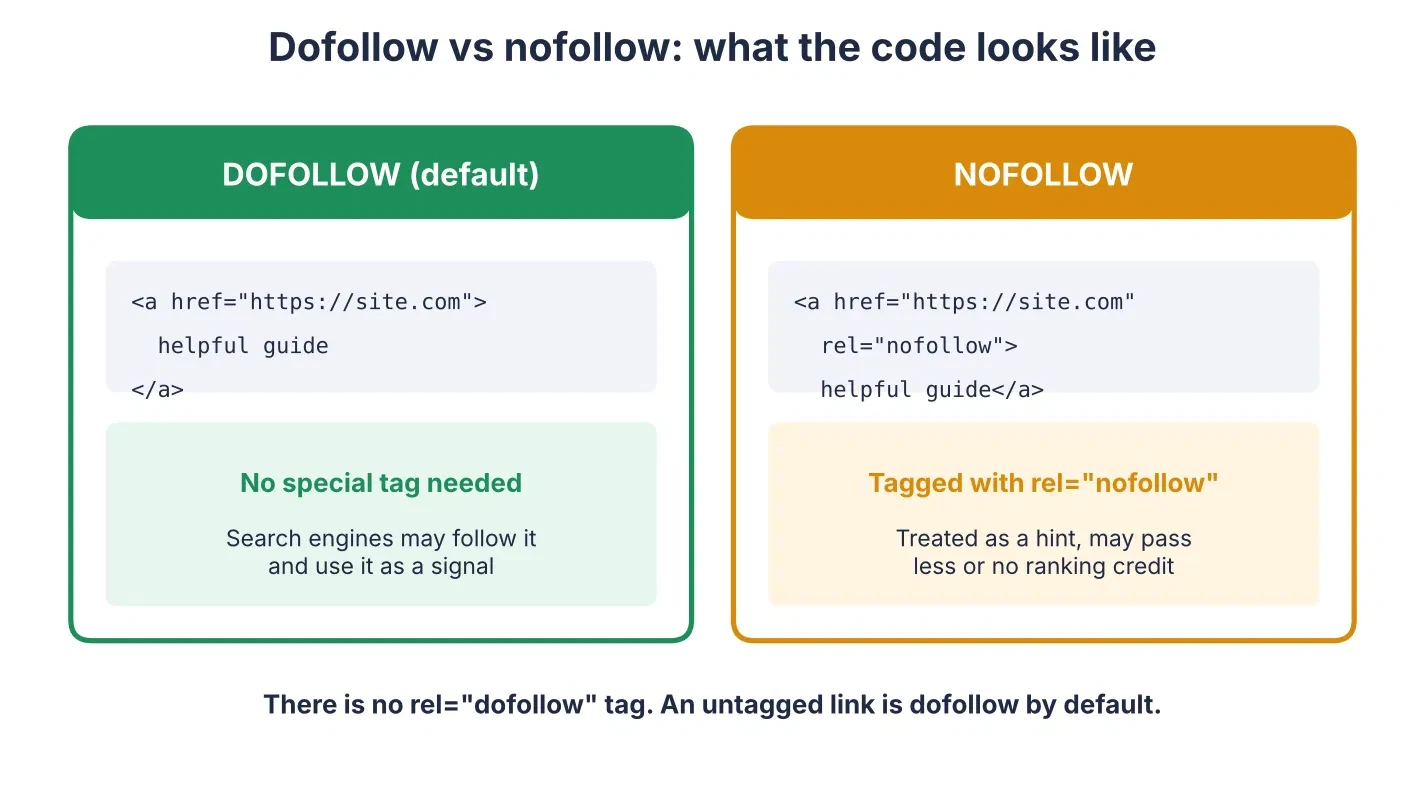
Google introduced the sponsored and UGC labels in 2019, and since March 2020 it has treated all three labels as hints rather than strict commands. Here is how the types line up:
|
Link type |
HTML tag |
What it tells search engines |
Typical example |
|---|---|---|---|
|
Dofollow |
None |
A normal link the site is happy to vouch for |
A journalist cites your research |
|
Nofollow |
|
The site doesn't want to endorse the destination |
A link in a forum signature |
|
Sponsored |
|
The link was paid for or part of an ad deal |
An advertorial or paid partnership |
|
UGC |
|
The link was added by a user |
A blog comment or forum post |
In short, the labels describe the relationship behind the link, not its worth to you as a visitor.
Why do dofollow backlinks matter for SEO?
Links are one of the ways search engines judge whether a page deserves attention. A dofollow link from a respected, relevant site is a clear signal that someone chose to point readers your way. That can help in several ways:
- Authority. Links from trusted sites support the idea that your content is credible.
- Discovery. Crawlers follow links, so a good dofollow link helps new pages get found sooner.
- Rankings. Google has long said links are one of many signals in its systems, though no one outside the company knows how much any single link weighs.
- Referral traffic. A link in a well-read article brings readers who care about the topic.
Two honest cautions. First, a dofollow link is only worth what the site behind it is worth. A link from a relevant, trusted site beats ten from sites nobody reads. Second, links work alongside great content, not instead of it.
Are nofollow links useless?
No, and chasing only dofollow links is a common mistake. Nofollow links:
- Can still send visitors. A nofollow link in a popular article may bring more readers than a dofollow link on an unknown site.
- Build awareness. People who see your brand mentioned in a trusted place remember it.
- May still be noticed. Google treats nofollow as a hint, so it can sometimes use those links as a signal.
- Make your profile look natural. Real sites collect a mix of link types. A profile of nothing but dofollow links looks odd.
Major platforms such as Wikipedia, many social networks and most blog comment systems use nofollow or ugc by default. Getting a link from them still matters if the audience is right.
If you're paying for a placement, the right label is rel="sponsored". Asking for a paid link to be left as plain dofollow runs against Google's spam policies.
How can you check if a backlink is dofollow?
You can do it in under a minute, and you don't need paid software.
- Open the page that holds the link.
- Right-click the link and choose Inspect (or Inspect Element).
- Read the anchor tag that's highlighted. If you see
rel="nofollow",rel="sponsored"orrel="ugc", it's not a standard dofollow link. If none of those appear, it's dofollow. - Mind the page-level setting. A page can also carry a robots meta tag with
nofollow, which applies to every link on it. Search the page source fornofollowto be sure.
For many links at once, a free browser extension that highlights nofollow links, or a backlink tool such as Ahrefs, Semrush or Moz, will list each link's type. Google Search Console's Links report shows which sites link to you, though it doesn't label the link type.
One reminder: finding out that a link is dofollow only tells you its tag. Whether it's a good link still depends on relevance, trust and placement.
How do you earn dofollow backlinks the right way?
You don't ask for "dofollow." You earn links worth having, and most of those arrive untagged. These methods hold up over time:
- Publish original research. Data nobody else has is something writers want to cite.
- Create genuinely useful resources. Free tools, templates and in-depth guides get shared and linked.
- Do digital PR. Offer journalists a real story or an expert quote. Respected publications often link with a plain, followed link.
- Write guest posts for relevant sites. Give real value to the audience, not a thinly veiled ad.
- Fix broken links. Tell a site owner about a dead link on their page and suggest your relevant page as a replacement.
- Reclaim unlinked mentions. When someone names your brand without linking, a friendly note often fixes it.
When you reach out, be specific and polite, and never make the "dofollow" part of the request. Editors choose how to link, and pressing the point can sound like you're after a transaction.
Skip anything that promises a pile of dofollow links for a flat fee. Paid links that pass ranking credit, private blog networks and link swaps at scale are the kind of shortcuts Google's spam policies target.
Do dofollow links matter for AI search?
Indirectly, at most. People now get answers from tools such as Google's AI Overviews, ChatGPT search and Perplexity, and those tools often cite web pages. Nobody outside the companies knows exactly how they pick sources, and none of them publishes a rule about dofollow tags.
What seems reasonable is this: pages that do well in search and are mentioned on reputable sites tend to look more trustworthy, so the signals behind a good dofollow link, relevance, reputation and real expertise, can help in both places. The tag itself isn't the point. The trust behind the link is.
To be a good candidate for citation:
- Lead with a clear, direct answer to the question your page targets.
- Earn mentions on respected, relevant sites, with or without a followed link.
- Keep brand and author details consistent across the web.
- Keep your facts fresh and sourced.
The lesson for GEO is the same as for SEO: stop counting tags and start earning trust.
Dofollow backlinks FAQ
What is a dofollow backlink in simple words?
A dofollow backlink is a normal link from another website to yours, with no nofollow, sponsored or UGC label. Search engines can follow it and treat it as a signal.
Is there a rel="dofollow" tag?
No. Links are dofollow by default. You only add a rel attribute when you want to mark a link as nofollow, sponsored or UGC.
Are dofollow links better than nofollow links?
Dofollow links are usually more valuable for SEO, but quality matters more than the tag. A relevant nofollow link from a respected site can beat a dofollow link from a weak one.
Do I need only dofollow backlinks?
No. A natural profile has a mix of types. Chasing only dofollow links can look forced and ignores the traffic and awareness that other links bring.
How do I check if a backlink is dofollow?
Right-click the link, choose Inspect, and look at the anchor tag. If there's no nofollow, sponsored or ugc value in the rel attribute, it's dofollow.
Can you buy dofollow backlinks?
It's risky. Google's spam policies treat paid links that pass ranking credit as a violation. Paid placements should be labeled rel="sponsored".
Final thoughts
A dofollow backlink is simply a link that hasn't been labeled otherwise, and it's the kind most sites hope to earn. But the tag isn't what makes a link valuable. Relevance, trust and a real audience are.
So don't chase a label. Create something worth citing, share it with people who'd care, and welcome the links that come, followed or not. Check your Links report in Google Search Console next month and see who has already noticed.