What are the types of backlinks, and which are the strongest?
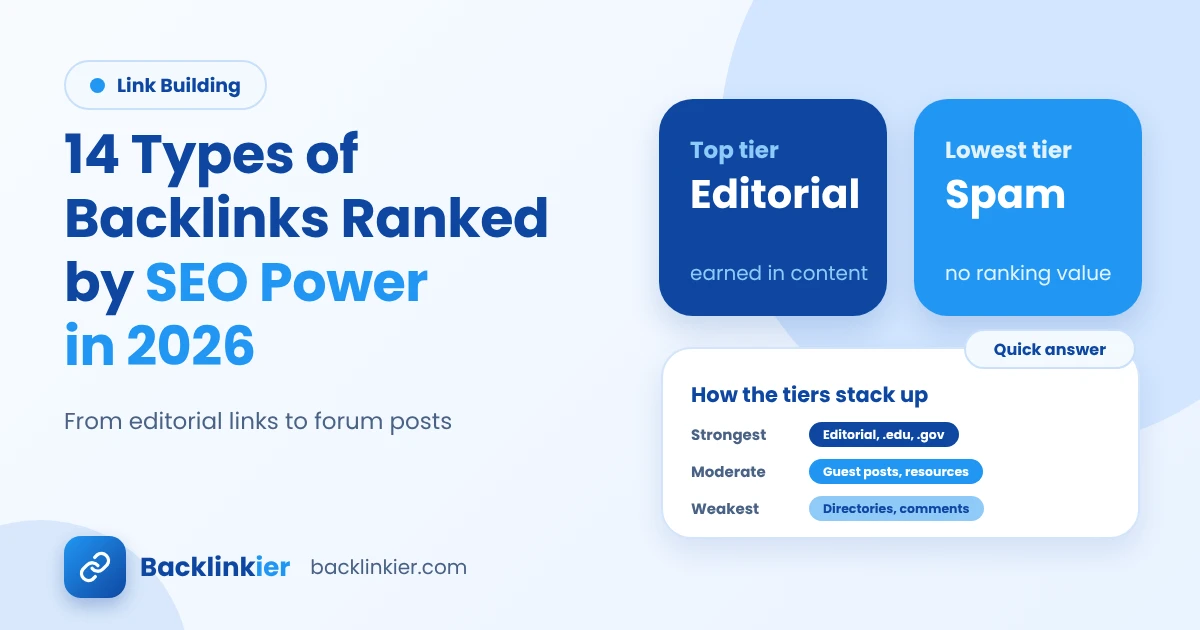
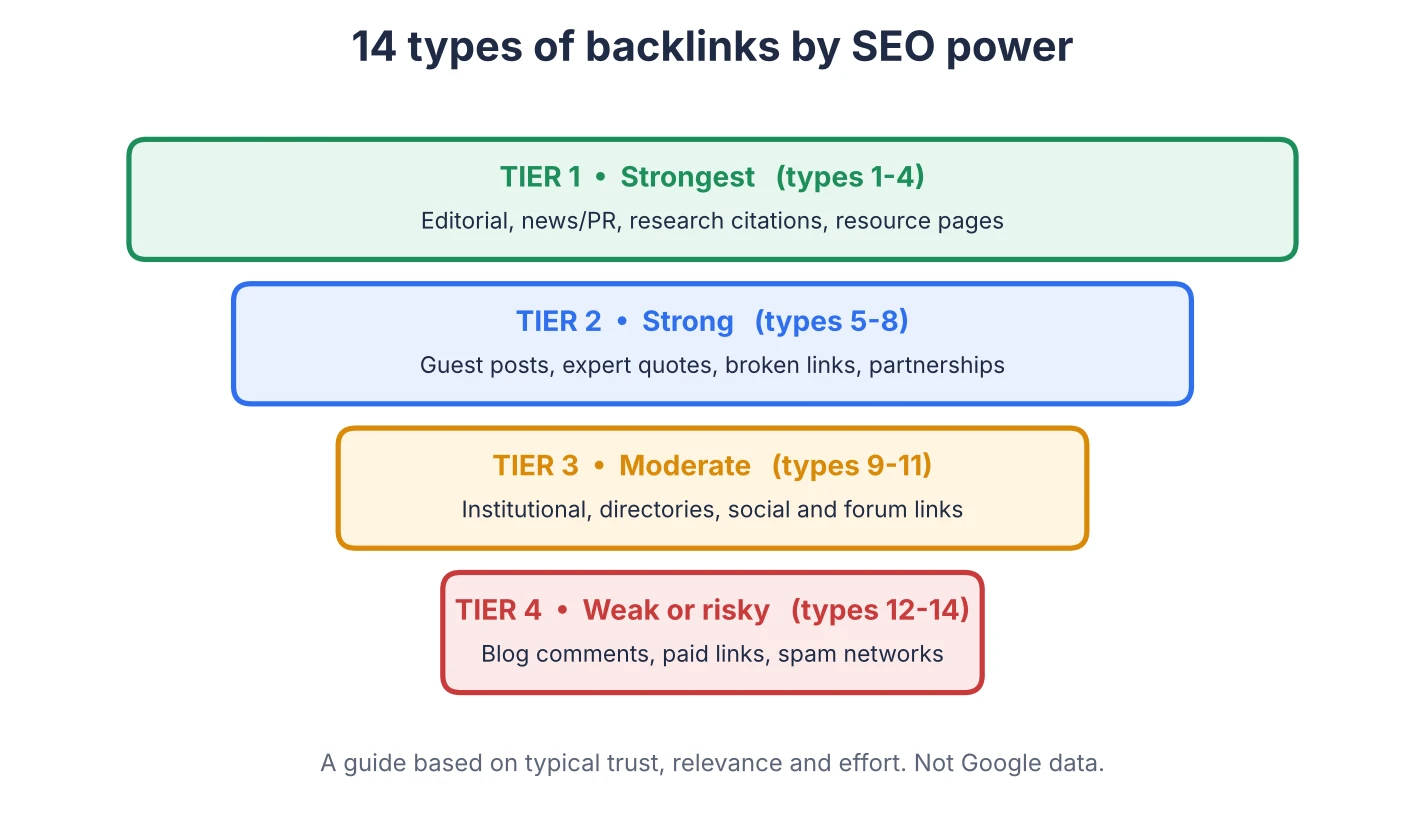
The main types of backlinks are editorial links, news and PR links, research citations, resource page links, guest post links, expert quotes, broken link replacements, partnership links, institutional links, directory links, social and forum links, blog comment links, paid links and spam network links. Editorial links from trusted, relevant sites generally carry the most SEO power. This guide ranks 14 types of backlinks by SEO power in 2026, so you can see which backlinks ranked by SEO power deserve your time, which are only supporting players, and which can hurt you. The best types of backlinks are earned, relevant and natural, and they make up the high-quality backlinks every site wants.
How are these types of backlinks ranked by SEO power?
Google doesn't publish a list of link types and their weights, and no one outside the company knows the exact formula. So this ranking is an editorial judgment, built on four things that SEO professionals broadly agree matter:
- Trust. Is the linking site a credible, well-edited source?
- Relevance. Does its topic match yours?
- Naturalness. Was the link given because the content earned it?
- Difficulty and scale. Links that are hard to get tend to carry more value than links anyone can create.
Treat the order as a guide, not a law. A relevant link from a small niche site can beat an irrelevant link from a giant one, and a single type can range from excellent to useless depending on the site.
Tier 1: the best types of backlinks (1 to 4)
1. Editorial backlinks
These are links a writer or editor chooses to add because your content helped their readers. They sit naturally in the body of an article, come from relevant sites and carry no payment. They're the closest thing to what search engines originally set out to reward, so they lead the list. You earn them with content worth citing, such as clear guides, tools and original data.
2. News and digital PR links
Coverage in respected news sites and trade publications brings links from sources with strong reputations. Digital PR also builds brand mentions, which can help beyond the link itself. They're harder to win and usually need a real story, such as a study, an expert comment or a newsworthy launch.
3. Original research and data citations
When other sites cite your survey, benchmark or study as a source, those links are natural and often come from authoritative pages. They also keep arriving over time as more writers find the data.
4. Resource page links
Curated lists of helpful tools and guides on relevant sites can send targeted visitors and carry good context. The key is that the page's owner chose each entry. Your content has to be genuinely useful for the list to include it.
Tier 2: strong types of backlinks (5 to 8)
5. Relevant guest post links
A guest post on a respected site in your field can earn a link in the article or author bio. The value depends on the site's quality and relevance. Google has warned against large-scale guest posting campaigns built mainly for links, so keep it selective and useful.
6. Expert quote links
Journalists and bloggers often look for expert comment. When your quote is used, you commonly get a link to your site. These links come from real articles and build authority in your niche.
7. Broken link replacements
You find a dead link on a relevant page and suggest your working page as a replacement. It helps the site owner fix a problem, and the new link usually sits in a relevant context. It takes research and polite outreach, but it's repeatable.
8. Partnership, sponsor and testimonial links
Genuine business relationships often produce links: a supplier's customer page, a testimonial on a vendor's site, or a local event you sponsor. They're honest and relevant. Be aware that links earned through paid sponsorships may need a rel="sponsored" label.
Tier 3: moderate types of backlinks (9 to 11)
9. Institutional links (.edu, .gov and similar)
Links from universities, public bodies and nonprofits can be credible and hard to fake, so they're often prized. But the domain ending isn't magic. A link from a random student page is worth far less than one from a respected research page. Judge the specific page, not the extension.
10. Business directory and citation links
Listings in relevant, well-run directories help people and search engines verify your business, which is especially useful for local SEO. Many are nofollow and the ranking effect is small, but a handful of quality listings is a sensible foundation. Skip low-quality directories that accept anything.
11. Social profile and forum links
Links in social bios, community answers and forum posts are usually nofollow or rel="ugc". They bring visitors and awareness more than ranking credit. They're useful as part of a natural mix, as long as you add value instead of dropping links.
Tier 4: low-value and risky types of backlinks (12 to 14)
12. Blog comment links
Most are nofollow or ugc and easy to create, so they carry little ranking power. Done thoughtfully, they can bring visitors and relationships. Done at scale, they look like spam.
13. Paid and sponsored links
Paying for advertising or sponsored content is fine, but links meant to pass ranking credit break Google's spam policies unless they're labeled rel="sponsored". Labeled sponsored links can bring traffic and exposure, though not much ranking help.
14. Spam network links
Private blog networks, link farms, hacked-site links and auto-generated links sit at the bottom. They're built to manipulate rankings, search engines work to ignore or penalize them, and they can leave you with a messy clean-up. Avoid them.
Backlinks ranked by SEO power: the full list at a glance
|
Rank |
Type of backlink |
SEO power |
Typical link tag |
Effort |
|---|---|---|---|---|
|
1 |
Editorial links |
Very high |
Dofollow |
High |
|
2 |
News and digital PR links |
Very high |
Mostly dofollow |
High |
|
3 |
Research and data citations |
Very high |
Mostly dofollow |
High |
|
4 |
Resource page links |
High |
Dofollow |
Medium |
|
5 |
Relevant guest post links |
High |
Varies |
Medium |
|
6 |
Expert quote links |
High |
Mostly dofollow |
Medium |
|
7 |
Broken link replacements |
High |
Dofollow |
Medium |
|
8 |
Partnership and sponsor links |
Medium to high |
Varies |
Medium |
|
9 |
Institutional links |
Medium |
Varies |
High |
|
10 |
Directory and citation links |
Low to medium |
Often nofollow |
Low |
|
11 |
Social and forum links |
Low |
Nofollow or ugc |
Low |
|
12 |
Blog comment links |
Low |
Nofollow or ugc |
Low |
|
13 |
Paid and sponsored links |
Low for rankings |
Sponsored |
Varies |
|
14 |
Spam network links |
None or negative |
Varies |
Low |
How do you build a balanced mix of high-quality backlinks?
You don't pick one type. A healthy profile mixes several, weighted toward the top.
- Start with a page worth linking to. Original data, a free tool or a really clear guide gives every other tactic something to work with.
- Put most effort into tiers 1 and 2. Digital PR, research, resource pages, quotes and selective guest posts.
- Add the basics. A few relevant directory listings and complete social profiles.
- Let the rest happen naturally. Comments, forum answers and nofollow mentions appear on their own as you become known.
- Vary your anchor text and sources. Natural profiles look varied.
- Review regularly. Check your Links report in Google Search Console every few months.
There's no official ideal ratio, so ignore anyone who quotes one. Aim for what a genuinely useful site would collect over time.
Which types of backlinks matter for AI search?
Nobody outside the AI companies knows exactly how tools such as Google's AI Overviews, ChatGPT search and Perplexity choose their sources, so be careful with confident claims. What seems reasonable is that trusted, relevant mentions help, and those come mostly from the top tiers: editorial links, news coverage and research citations.
To be a likely source:
- Publish original, quotable facts that others want to cite.
- Earn mentions on respected sites, with or without a followed link.
- Keep brand and author details consistent everywhere you appear.
- Lead with clear, direct answers on your pages.
The backlinks that help in classic search and the mentions that help in AI search have the same root: trust earned from relevant, reputable sources.
Types of backlinks FAQ
What are the main types of backlinks?
The main types are editorial links, news and PR links, research citations, resource page links, guest post links, expert quotes, broken link replacements, partnership links, institutional links, directory links, social and forum links, blog comment links, paid links and spam network links.
Which type of backlink is best for SEO?
Editorial backlinks from trusted, relevant sites are generally considered the strongest because they're earned and natural.
Are .edu and .gov backlinks better?
Not automatically. They can be strong, but the value depends on the page and its relevance, not just the domain ending.
Are nofollow backlinks worth having?
Yes. They carry less ranking credit but can bring visitors, awareness and later dofollow links. Google treats nofollow as a hint.
Which backlinks can hurt my site?
Spam network links, hacked-site links and unlabeled paid links built to manipulate rankings can lead to ignored links or penalties.
How many types of backlinks should I build?
As many as feel natural for your business. Focus on a few high-quality types instead of trying all 14.
Final thoughts
The strongest types of backlinks share one thing: someone chose to give them. Spend most of your effort on editorial, PR, research and resource links, treat the lower tiers as supporting players, and stay away from the bottom of the list.
Pick one top-tier tactic this month, such as publishing a small original study, and build your plan around it.