Learning how to get relevant backlinks to your website is one of the smartest investments you can make in SEO. A link from a site your audience actually reads says far more than a link from a random directory. Relevant backlinks show search engines that your page belongs to a topic, they send visitors who care, and they hold up when algorithms change. In this guide you will learn how topical relevance works, eight link building strategies that earn high-quality backlinks, and how to check a link before you spend time chasing it.
What Are Relevant Backlinks?
Relevant backlinks are links from websites and pages that cover a topic closely related to yours, placed in content where the link makes sense for the reader. A link to a running shoe review from a marathon training blog is relevant. The same link from a mortgage calculator page is not.
Relevance works at more than one level:
- Site to page: the whole website covers your subject, and the page you want linked fits it.
- Page to page: the article that links to you discusses the same topic as the page it points to.
- Audience: the people reading the linking page would genuinely want what you offer.
- Location: for local businesses, a link from another business in your city usually means more than one from a different region.
Why Relevant Backlinks Matter More Than Link Count
Search engines use links as a signal that other people consider your page worth citing. But the signal is stronger when the citing page is a natural fit. A link from a topical neighbor looks like a real recommendation. A link from an unrelated site looks like something that was arranged.
There are three practical reasons to put relevance first:
- Stronger ranking signal. Links from related sites reinforce the topic your page should rank for.
- Better traffic. People who click from a related article are far more likely to be interested in what you do.
- Lower risk. A profile full of off-topic links is a common pattern in link schemes, and Google can ignore or act on links it sees as manipulative.
That is why a handful of relevant links often beats dozens of random ones.
How to Check Topical Relevance Before You Pitch
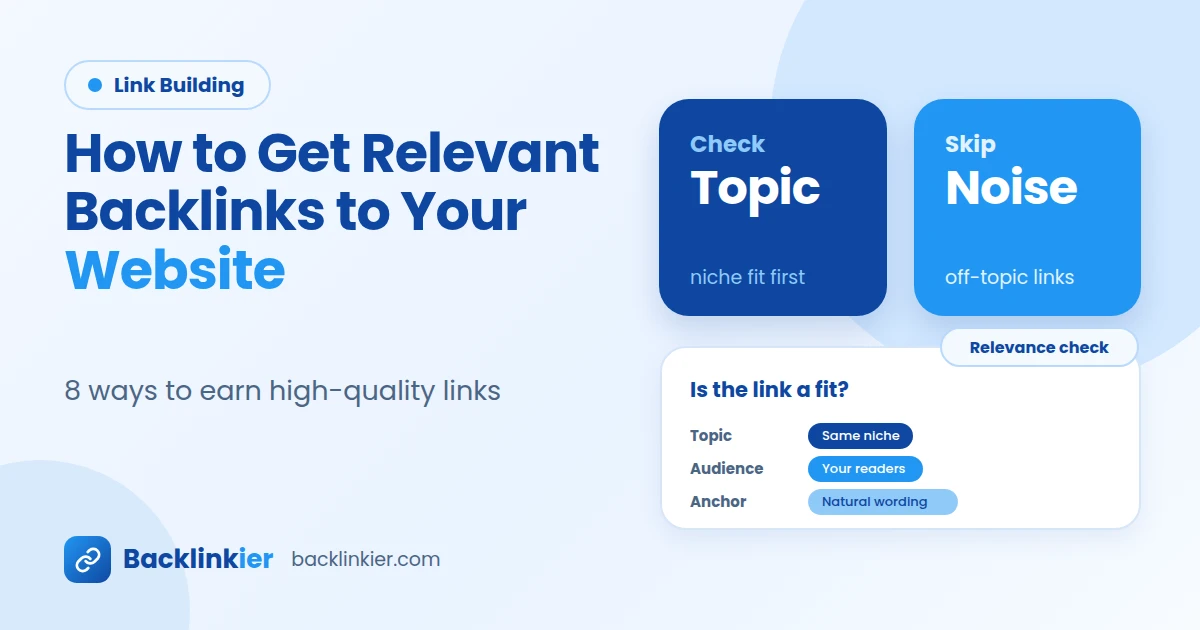
Before you spend time on any prospect, run it through five quick questions:
- Does the site mainly cover my topic, or is it a general site that publishes everything?
- Would the page that could link to me make sense to a reader without the link?
- Does the site have real traffic, real authors and an editorial standard?
- Is the site linking to similar pages already?
- Would I be happy to be mentioned there even if the link were nofollow?
If you can answer yes to at least four, the prospect is worth a personal pitch. If the answer to the last question is no, the link is probably not about relevance at all.
How to Get Relevant Backlinks to Your Website: 8 Proven Strategies
1. Create assets that are naturally worth linking to
People link to things that help them make a point: original data, in-depth guides, templates, calculators and clear explanations. The key is to make assets for your own niche, because the sites that link to them will already be related to it.
Before writing, search the topic and look at what already ranks. Then build something more complete, more current or more useful, and give it a clear page that is easy to cite.
2. Use digital PR and expert commentary
Journalists and editors need sources, quotes and data. When you provide something useful, they link to you in return. The classic HARO service has shut down, but several alternatives connect reporters with experts, so choose one or two that cover your industry and respond quickly with a specific, quotable answer.
The same approach works for trends. Comment on news in your niche with a real point of view, and you give writers a reason to name and link to you.
3. Study your competitors’ backlinks
Your best prospects are often the sites already linking to several competitors. Use a backlink tool to find domains that link to three or more of your rivals but not to you, then look at the pages doing the linking. Were they roundups, guides, resource lists or product mentions?
This shortcut gives you a list of sites that are already relevant and already open to linking to businesses like yours. Don’t copy links blindly. Look for gaps where you can offer something better.
4. Guest post on sites in your niche
Guest posting still works when it is done selectively. Google has said it is not against its guidelines by itself, but large-scale campaigns whose main aim is building links back to your site are a problem. So write a small number of genuinely useful articles for related sites that have real readers and editors.
Keep the link natural, use a descriptive anchor, and put most of the promotion in the author bio.
5. Pitch resource pages and fix broken links
Many sites keep curated lists of useful tools, guides and references. If your content fits a list and belongs there, suggest it politely. You can also look for relevant pages that link to dead resources and propose your guide as a replacement.
Both tactics work because they help the site owner. They are also naturally relevant, since the page is already about your topic.
6. Reclaim unlinked mentions
Sometimes people mention your brand, your product or your research without linking. Set up alerts for your name and your key assets, then send a short, friendly request asking the writer to add a link. It is quick, relevant by definition and often the easiest win on this list.
7. Build partnerships and association links
Suppliers, customers, industry associations, local business groups, event organizers and community organizations all publish pages that can link to you. A partner page, a member directory or a sponsor listing is not glamorous, but it is relevant, trustworthy and difficult for competitors to replicate overnight.
8. Appear on podcasts, webinars and interviews
Being a guest on a show in your niche usually earns a link in the show notes or an accompanying article, plus exposure to an audience that already cares about your topic. Pitch ideas, not just yourself, and offer a specific story the host’s audience will find useful.
How to Evaluate High-Quality Backlinks
Relevance comes first, but it is not the only thing that matters. A strong link usually has most of these traits:
- Topical fit: the site and page cover your subject.
- Editorial placement: the link sits inside real content, not in a footer or a list of dozens of links.
- Trust: the site has a real audience, clear authorship and a clean reputation.
- Traffic potential: people could realistically click through.
- Natural anchor text: brand names, URLs and descriptive phrases rather than exact-match keywords every time.
For anchor text, a healthy profile is mostly branded and natural anchors, with some partial-match phrases where they fit the sentence. Heavy use of exact-match anchors is an easy pattern to spot.
Link Building Mistakes That Attract Irrelevant Links
- Chasing authority scores. A big site that has nothing to do with your topic is a weak link.
- Buying links. Paid links that pass ranking credit break Google’s spam policies unless they are qualified with rel=sponsored or rel=nofollow.
- Mass outreach with templates. Blasting hundreds of generic emails earns few links and damages your reputation.
- Directory and comment spam. These links are rarely relevant and rarely valuable.
- Over-optimized anchors. Keyword-stuffed anchor text looks forced.
- Giving up after one campaign. Relevant links come from steady effort over months, not one burst.
How to Measure Relevant Backlink Results
Stop asking only how many links you have. Ask how relevant and valuable they are.
- Relevance of referring domains: what share of your new links come from sites in your niche.
- Link context and placement: are the links inside useful content?
- Rankings and impressions: movement for the pages you promoted, in Google Search Console.
- Referral traffic and conversions: visits and leads from linking pages, in Google Analytics.
- Brand searches: growth in people searching for your name.
Give each campaign two to three months before judging it, and review your existing links through a relevance lens at least once a quarter.
FAQs About How to Get Relevant Backlinks to Your Website
How do I get relevant backlinks to my website?
Create content worth citing, then earn links from related sites through digital PR, competitor backlink gap research, niche guest posts, resource page outreach, unlinked mention reclamation, partnerships and interviews. Focus on sites your audience already trusts.
What is a relevant backlink?
A relevant backlink comes from a website or page on a topic closely related to yours, placed in content where the link genuinely helps the reader.
Are relevant backlinks better than high-authority backlinks?
They are not mutually exclusive, but relevance should come first. A relevant link from a smaller, trusted niche site is usually more useful than a link from a high-authority site that has nothing to do with your topic.
How long does it take to get relevant backlinks?
Some mentions can be earned within weeks, but most campaigns take two to three months to show results, and ranking improvements can take longer.
Can I buy relevant backlinks?
Paying for links that pass ranking credit goes against Google’s spam policies. Paid or sponsored placements should be labeled with rel=sponsored or rel=nofollow, and they should be a small part of your strategy.
How many backlinks do I need to rank?
There is no fixed number. Compare the relevant referring domains of the pages outranking you and aim to earn fewer, better links rather than chasing volume.
Final Thoughts on Getting Relevant Backlinks
The most reliable way to get relevant backlinks to your website is also the least flashy: make something genuinely useful for your niche, then put it in front of the people who already write about that topic. Check every prospect for fit, keep your anchors natural, and be patient. Over time, the right links add up to rankings, traffic and a reputation that no shortcut can fake.