Knowing how to build backlinks for ecommerce is often the difference between a store that ranks and one that stays buried on page three. Product pages are hard to link to, because almost nobody shares a listing for a pair of running shoes. That is why ecommerce link building looks different from other niches, and why the best link building strategies lean on useful content, digital PR and real partnerships. This guide shows you how to earn backlinks for online stores, strengthen your ecommerce SEO, and avoid shortcuts that put your rankings at risk.
What Does It Mean to Build Backlinks for Ecommerce?
Building backlinks for ecommerce means earning links from other relevant websites to your store’s product pages, category pages and content, so search engines see your site as a trusted source and rank it higher. In practice, most of the links come to guides, research and resources, and your category and product pages benefit from that authority through internal links.
The core idea is simple. You give publishers, bloggers and partners a reason to mention you, then you make it easy for them to link to the right page.
Why Backlinks Matter for Ecommerce SEO
On-page and technical SEO get your store ready to compete. Backlinks help decide who wins when several stores sell nearly the same thing. In a crowded category, a page with strong, relevant links tends to have an edge over one with none, even when the product pages are equally good.
Ecommerce has a few quirks that make links harder to earn:
- Transactional intent. Many pages exist to sell, so they give a publisher little reason to cite them.
- Thin, repeated content. Product pages with manufacturer descriptions look the same across many stores.
- Limited editorial angles. A blender listing is not a story. A guide to choosing a blender is.
That is why most successful ecommerce link building starts with something worth linking to, not a product page.
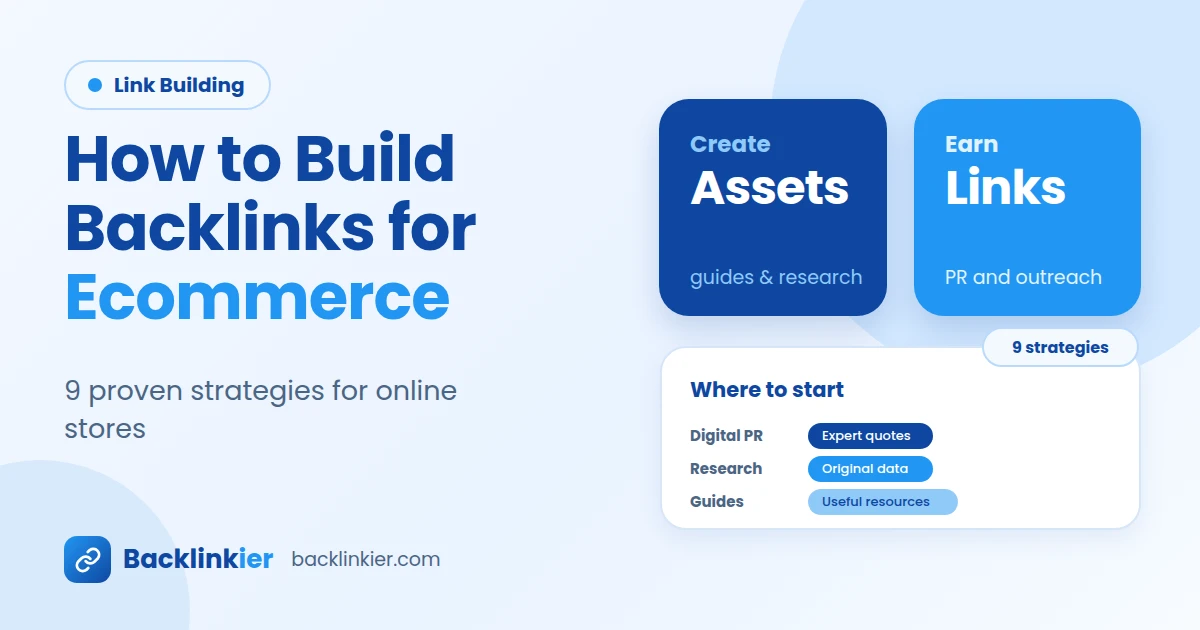
How to Build Backlinks for Ecommerce: 9 Strategies That Work
1. Use digital PR for ecommerce
Digital PR means earning press mentions and links by giving journalists something useful: expert comments, data, a trend story or a genuinely interesting product angle. It is widely described as one of the most effective link building tactics right now.
One thing to know: the old HARO service has shut down, but several alternatives still connect journalists with sources. Pick one or two, set up alerts for your category, and respond fast with a specific, quotable answer. A reply with a real insight, a number and a name gets used far more often than a generic pitch.
2. Publish original research
Publishers love fresh data. If you sell pet products, survey a few hundred pet owners. If you sell outdoor gear, analyze your own sales trends by season. Even a small, honest dataset gives writers something citable that no competitor can copy.
Present the findings clearly, with a short summary, two or three charts and a simple way to embed or reference them. Then pitch it to the publications that already cover your niche.
3. Create linkable guides and tools
Buying guides, size charts, comparison pages, calculators and how-to content attract links because people use them as references. A good size guide, for example, can be cited for years.
Build these on your own domain, link them to your relevant category pages, and make them better than what already ranks.
4. Mine your competitors’ backlinks
The best prospects are rarely the biggest sites. They are the sites already linking to several of your competitors but not to you. Use a backlink tool to find domains that link to three or more competitors, then look for why they linked: a guide, a roundup, a resource page or a product mention.
If you can offer something comparable or better, your outreach has a clear, relevant reason to exist.
5. Turn supplier and brand relationships into links
If you stock other brands, ask whether they list retailers on a where-to-buy or stockist page. Manufacturers, distributors and trade associations often link to authorized sellers, and these links are relevant by default.
The same goes for partners, local business groups and industry bodies you belong to.
6. Run a careful product review program
Sending products to reviewers and bloggers can earn mentions and links, but the rules matter. If you give a product for free in exchange for coverage, that is value changing hands, and Google expects those links to be qualified with rel=sponsored or rel=nofollow. Be open about it, and choose reviewers your customers actually trust.
7. Reclaim unlinked brand mentions
Sometimes people mention your store without linking to it. Set up alerts for your brand and product names, then send a short, friendly note asking the writer to add a link. This is one of the lowest-effort wins available, because the writer already knows and likes you.
8. Use broken link and resource page outreach
Find relevant pages that link to dead resources, then suggest your guide as a replacement. Or search for resource pages in your niche and pitch your most useful content for inclusion. Both approaches work because you are helping the site owner fix or improve something.
9. Build local and community links
Sponsoring a local event, partnering with a nearby business, joining a chamber of commerce or supporting a community project can all earn links from local news, organizations and directories. They are relevant, honest and hard for competitors to copy quickly.
Which Pages Should Get Backlinks on an Online Store?
Don’t try to build every link straight to a product page. Most publishers will not link to a plain listing, and links that all point to money pages can look forced.
A healthier approach for backlinks for online stores:
- Guides, research and tools: the pages most likely to earn links naturally.
- Category pages: your biggest ranking opportunity, supported by links from guides and some direct editorial links.
- Product pages: link to them where it is genuinely relevant, such as a review or a roundup, and strengthen them with internal links from your best pages.
- Homepage: earns brand links from press, partners and mentions.
Then use internal linking to pass authority from your strongest pages to the categories and products you want to rank.
Link Building Strategies to Avoid
Some shortcuts do more harm than good. Google’s spam policies treat link spam as a practice done mainly to manipulate rankings, and it can ignore those links or take action.
- Buying dofollow links. Paid links that pass ranking credit break the rules unless they are labeled with rel=sponsored or rel=nofollow.
- Private blog networks and link farms. They look artificial and are easy to spot at scale.
- Mass guest posting with keyword-rich anchors. Large-scale article campaigns for links are a known problem.
- Comment and forum spam. It rarely helps and can hurt.
- Exact-match anchor text everywhere. A natural profile includes brand names, URLs and descriptive phrases.
How to Measure Ecommerce Link Building Results
Links are a means to an end, so track what they change:
- Referring domains: how many new, relevant sites link to you each month.
- Rankings: movement for your target category and product keywords, in Google Search Console.
- Organic traffic and revenue: visits and sales from search, in Google Analytics.
- Referral traffic: clicks coming from the linking pages.
- Brand searches and AI mentions: whether more people search for your store, and whether it appears when you ask AI search tools about your category.
Give campaigns at least two to three months before judging them, and compare pages you built links to against similar pages you did not.
A Simple 90-Day Plan for Ecommerce Link Building
- Month 1: Foundations. Audit your current backlinks, find your top competitors’ link sources, and choose two assets to build, such as a buying guide and a small research study.
- Month 2: Create and launch. Publish the assets, set up journalist and brand-mention alerts, and start reclaiming unlinked mentions.
- Month 3: Outreach and expand. Pitch your research and guides to relevant publishers, contact suppliers and partners, and review what earned links so you can repeat it.
Then repeat the cycle. Steady, relevant links beat a short burst of activity.
FAQs About How to Build Backlinks for Ecommerce
How do I build backlinks for an ecommerce website?
Create content worth linking to, such as guides, research and tools, then earn links through digital PR, competitor link gap analysis, supplier relationships, brand mention reclamation and local partnerships. Point authority to product and category pages with internal links.
What is the best link building strategy for ecommerce?
Digital PR combined with original research is widely considered the strongest approach, because it earns relevant editorial links and brand mentions. Pair it with guides and supplier links for steady results.
How many backlinks does an ecommerce site need?
There is no fixed number. Check how many relevant referring domains the pages outranking you have, and aim to earn a smaller number of better links rather than chasing volume.
Can I buy backlinks for my online store?
Paying for links that pass ranking credit goes against Google’s spam policies. Paid or sponsored placements are acceptable only when the link is qualified with rel=sponsored or rel=nofollow, and even then they should be a small part of your strategy.
Should backlinks go to product pages or category pages?
Both, but in different ways. Earn most links to guides and resources, give category pages direct editorial links where possible, and use internal links to support product pages.
Final Thoughts on Ecommerce Link Building
The stores that win at ecommerce link building are not the ones sending the most emails. They are the ones giving the web something worth linking to, then telling the right people about it. Start with one strong asset, build real relationships, label paid links honestly and measure what works. Over a few months, the links, the rankings and the sales tend to move together.