How many backlinks do I need to rank?
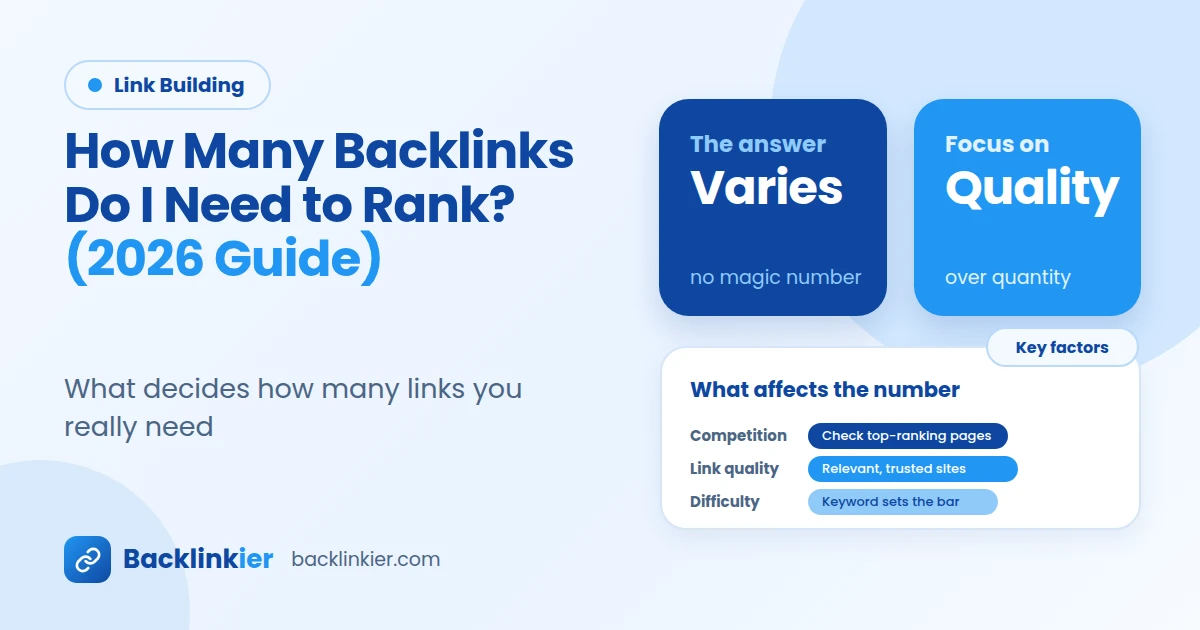
There's no fixed number. Pages with easy keywords can rank with a handful of good links, while competitive keywords may need dozens or even hundreds of linking sites. If you've wondered how many backlinks to rank on page 1, the honest answer is: about as many as the pages already ranking there have, and of similar quality. The number of backlinks needed depends on competition, and quality vs quantity backlinks matters more than any total. This beginner guide to backlinks for ranking in 2026 shows you how to work out your own target.
Why is there no magic number of backlinks to rank?
Because ranking isn't a points race with a finish line. Google uses many signals, and backlinks are only one of them. Whether a page ranks depends on things like:
- How competitive the keyword is. Ranking for a rare phrase is a very different job from ranking for "best credit cards."
- What the pages above you already have. Your target is relative to them, not to a universal figure.
- How well your page matches search intent. A page that answers the question clearly can beat a page with more links.
- The strength of your site overall. Established, trusted sites can often do more with fewer links.
- The quality of each link. One relevant link from a respected site can outweigh many weak ones.
Research does show a link between backlinks and rankings. A large Backlinko study of 11.8 million Google results found that the page in first position had, on average, about 3.8 times more backlinks than pages in positions two to ten. But it's a correlation study, so it shows an association, not proof that links alone caused the ranking. And it says nothing about the exact number you need.
How many backlinks to rank on page 1, by keyword difficulty
Here's a simple beginner breakdown. These ranges are rough rules of thumb based on common SEO experience, not figures from Google, and your own search results may differ. They count referring domains, meaning separate websites that link to the page, because ten links from one site count for far less than ten different sites.
|
Keyword type |
Example |
Linking sites top pages often have |
What to aim for |
|---|---|---|---|
|
Low competition |
Long-tail or local phrase, like "vegan bakery in Leeds" |
0 to 5 |
A few relevant links, plus excellent content |
|
Medium competition |
Specific product or topic term |
About 5 to 25 |
A steady plan of quality links over several months |
|
High competition |
Broad commercial term |
About 25 to 100 or more |
Strong content, authority and sustained link building |
|
Very high competition |
Head terms dominated by big brands |
Hundreds or more |
A long-term brand and PR effort |
The most reliable way to get your own number is to look at the pages currently ranking for your keyword, which we'll do next.
Quality vs quantity backlinks: which counts more?
Quality, almost every time. A single link from a relevant, respected site can do more than a hundred from sites nobody reads, and a pile of low-quality links can even work against you if they look manufactured.
A quality link usually has these traits:
- It comes from a relevant site. The topic matches yours.
- The site is trusted. Real content, real readers, clear authorship.
- It sits naturally in the content, not in a footer or a list of unrelated links.
- The anchor text is natural, not a repeated exact-match keyword.
- It comes from a new linking site. A second link from a site that already links to you adds less than a link from a brand-new one.
Quantity still plays a part. Pages that are very competitive usually do have a lot of links. But those links were earned over time, and they came from a variety of sources. Chasing the raw count is how people end up buying bulk links that Google's spam policies warn against.
How do you work out the number of backlinks needed for your keyword?
Use the competitor gap method. It takes about 20 minutes and gives you a target based on real results.
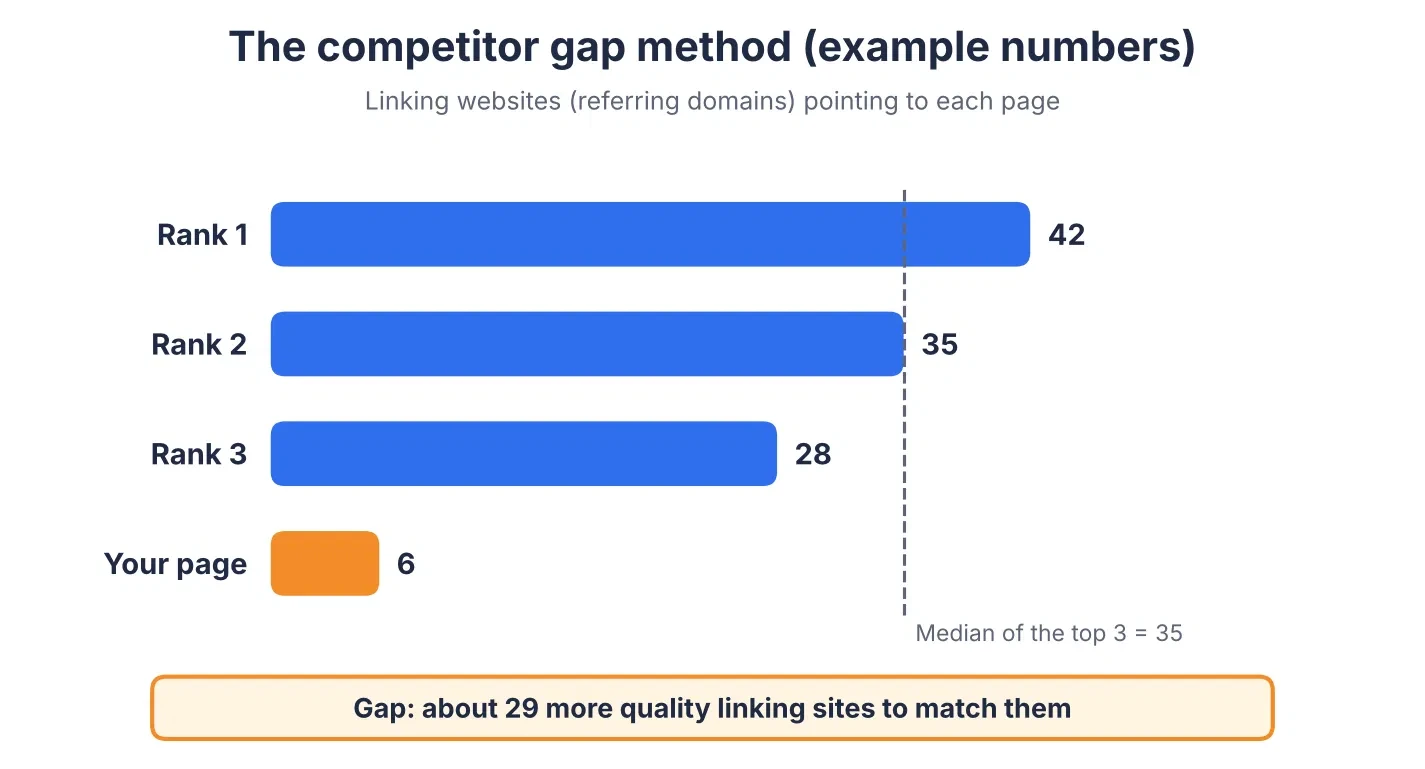
- Search your target keyword and note the pages ranking in positions one to five. Ignore giant brands like Wikipedia if you're a small site, and focus on pages that look like yours.
- Check each page's referring domains in a backlink tool such as Ahrefs, Semrush or Moz. Many offer a limited free check. Look at the number of separate linking websites, not the total number of links.
- Write down the numbers and find the middle value.
- Compare with your own page. The difference is your rough gap.
- Look at the quality of their links. Open a few of the linking pages. Are they editorial links from respected sites, or low-quality ones?
- Check the content too. If your page is thinner or less helpful than theirs, fix that first. Links won't cover for weak content.
- Set a realistic plan. Split the gap into monthly goals, such as 3 to 5 quality links a month.
The numbers in the chart are examples. Yours will be different for every keyword.
What matters about backlinks for ranking in 2026?
The basics haven't changed: links from trusted, relevant sites still help. What's shifted is how much weight is placed around them.
- Helpful content is the entry ticket. Google keeps stressing people-first content. Links can lift a good page, not rescue a weak one.
- Intent beats volume. A page that matches what searchers want often needs fewer links.
- Brand mentions and reputation matter more. Being talked about on respected sites builds trust beyond a single link.
- AI search adds a new layer. Tools such as Google's AI Overviews, ChatGPT search and Perplexity often cite pages that are well established and trusted. Nobody outside those companies knows the exact rules, so treat any "exact number" claim with caution.
- Spam detection keeps improving. Google's systems are good at ignoring manipulative links, so shortcuts are less likely to pay off.
The takeaway for a beginner: don't ask only how many links. Ask which links, from whom, and pointing to which page.
How can beginners get their first backlinks safely?
Start small and stay honest. These ideas work without a big budget:
- Make one page genuinely worth linking to. A clear guide, a free template, a checklist or a small original study.
- Claim the easy wins. Business directories that are relevant to your field, local listings and profiles on your own social accounts.
- Ask partners and suppliers. Customers, suppliers and local groups often link to people they work with.
- Contribute expert quotes. Journalists and bloggers regularly look for sources. A useful quote can earn a link.
- Write a guest post or two for relevant sites, giving real value to their readers.
- Fix broken links. Find dead links on relevant pages and suggest your page as a replacement.
- Reclaim unlinked mentions of your brand.
- Join the conversation. Thoughtful comments and community answers build awareness, even if those links are nofollow.
Avoid paid link packages, private blog networks and link swaps at scale. They can look tempting when you need numbers fast, but they're the very things Google's spam policies target.
What mistakes do beginners make when counting backlinks?
- Counting total links instead of linking websites. Fifty links from one site are worth far less than fifty from different sites.
- Copying a competitor's number blindly. A bigger, older site may have earned those links over many years.
- Trusting one tool's figures. Each tool crawls the web differently, so numbers vary.
- Ignoring your content. If your page doesn't match search intent, more links won't fix it.
- Buying links to hit a target. The quickest route to a penalty.
- Expecting overnight results. Links take time to be found and evaluated. Give them weeks to months.
- Forgetting internal links. Pointing your own pages to the one you're promoting helps spread the benefit.
- Never reviewing. Check your Search Console Links report every few months.
How many backlinks do I need to rank: FAQ
How many backlinks do I need to rank on Google?
There's no fixed number. Compare with the pages already ranking for your keyword. Easy keywords may need only a few quality links, while competitive ones can need dozens or more.
Can a page rank with zero backlinks?
Yes, especially for low-competition, long-tail searches where the content matches intent well. For harder keywords, links usually help.
How many backlinks per month is safe?
There's no official limit. Aim for a steady, natural pace that matches your size and industry, such as a few quality links a month for a small site, rather than sudden bursts.
Is one good backlink enough?
Sometimes, for a very easy keyword. One strong, relevant link can move the needle, but most pages benefit from several links from different sites.
Are referring domains more important than backlinks?
For judging progress, yes. Links from many separate websites usually show wider support than many links from a single site.
How long do backlinks take to work?
It varies. Links are usually found within days or weeks, but ranking changes can take a few months. Google itself says some changes take effect in hours and others take several months.
Final thoughts
The number of backlinks needed to rank depends on your keyword, your competitors and the quality of your page. Skip the hunt for a magic figure. Look at who ranks, measure the gap, and close it with links you'd be proud of.
Pick one keyword this week, run the competitor gap method, and write down your target. A clear number, even a rough one, turns link building from guesswork into a plan.