Link building outreach sounds simple at first.
You find websites, send emails, and expect backlinks in return. That’s the common belief most beginners have when they start.
But that’s not how it works in reality.
Most outreach campaigns fail, not because outreach doesn’t work, but because the strategy behind it is completely wrong.
According to Backlinko, the average outreach email gets a response rate of around 8.5%, which means more than 91.5% of emails are ignored.
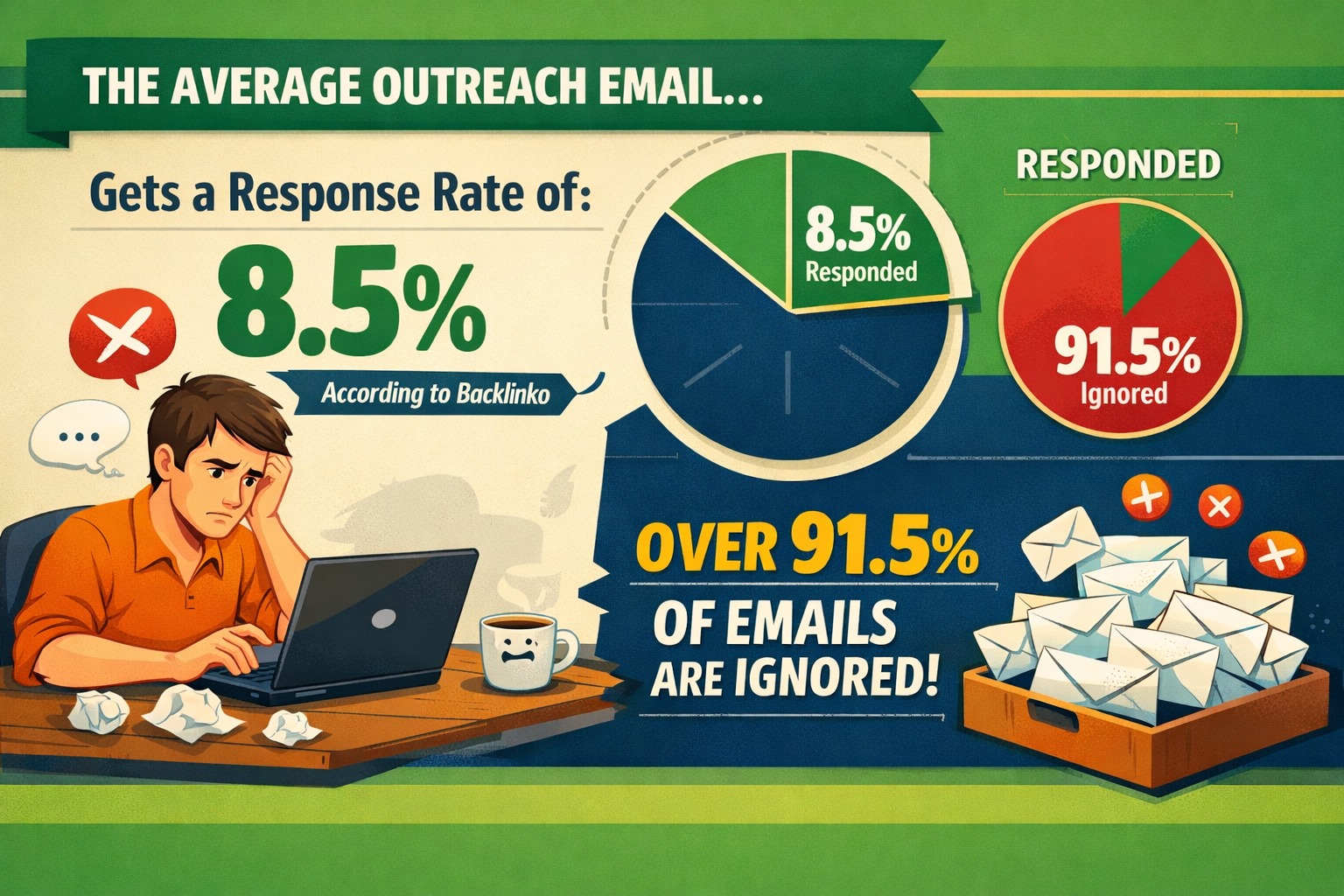
See! This clearly shows that outreach is not about sending more emails.
It’s about sending the right ones.
Link building outreach is the process of reaching out to website owners, bloggers, or editors to earn backlinks to your content.
But here’s where most people misunderstand it.
You are not asking for a link.
You are offering something valuable that deserves to be linked.
This could be a better resource, updated data, or content that adds something missing to their page.
That’s how you earn relevant backlinks that actually help rankings.
In simple terms, outreach is about connecting your content with the right people who already care about your topic.
Most beginners treat outreach like a numbers game.
They copy a template, send it to hundreds of websites, and hope that a few people will respond.
That approach rarely works.
Website owners receive dozens of outreach emails every day, and most of them look exactly the same.
Generic subject line, no personalization, and a direct request for a backlink.
See! That’s an instant ignore.
Another major mistake is targeting the wrong websites.
Many people don’t focus on relevance. They just look for sites that accept links or guest posts.
But Google doesn’t reward random backlinks.
It rewards relevant backlinks that make sense in context.
So even if you get a link from an unrelated site, it won’t carry much value.
A successful link-building campaign always starts with research, not emails.
You first need to identify websites that are already linking to content similar to yours.
This is where tools like Ahrefs or SEMrush help, as they allow you to analyze competitor backlinks and find real opportunities.
Once you have a list, the next step is filtering.
Not every website is worth your time.
Focus on websites that are relevant to your niche, publish quality content, and link out naturally.
After that, group your prospects based on type.
Some will be blogs, some resource pages, and others, potential guest posting sites.
Each of them requires a slightly different outreach approach.
See! Outreach works best when it is structured, not random.
Now comes the part most people obsess over.
The email.
But even a perfectly written email will fail if it is sent to the wrong person or the wrong website.
Still, writing a good link-building outreach email can significantly improve your chances.
The key is to keep it simple and natural.
Start by mentioning their content, show that you actually read it, and then explain how your content adds value.
Here’s a simple link-building outreach email example:
“Hi [Name],
I was reading your article on [topic] and found it really useful. I recently published a guide on [your topic] that includes updated data and additional insights.
I thought it might be a helpful addition to your page. Let me know what you think.”
That’s it.
No pressure, no sales pitch, and no forced request.
See! The goal is to start a conversation, not to push for a link.
Outreach involves multiple steps, and doing everything manually can slow you down.
This is where link-building outreach tools can help.
They allow you to find contact information, manage outreach campaigns, and track responses in one place.
Tools like Ahrefs, Hunter.io, and BuzzStream are commonly used for this purpose.
But it’s important to understand one thing.
Tools don’t make your outreach successful.
Your strategy does.
They only make the process more efficient.
Outreach takes time, consistency, and effort, which is why many businesses consider using a link-building outreach service or hiring a link-building outreach agency.
This can be a good option, but only if the service follows proper practices.
A reliable agency focuses on building relationships, reaching out manually, and securing backlinks from relevant websites.
They don’t rely on spammy tactics or mass link placements.
If a service promises hundreds of backlinks in a short time, that’s usually a sign of low-quality or risky methods.
See! Real outreach is slow, but it builds long-term value.
Outreach is not a one-time task.
It requires consistent follow-ups, tracking, and relationship building.
That’s why link-building outreach management plays an important role.
Most replies don’t come from the first email.
They come after a follow-up.
But the way you follow up matters.
A simple reminder is enough.
There’s no need to be aggressive or pushy.
Over time, this process helps you build connections that can lead to more backlinks in the future.
Many beginners look for shortcuts and try to learn how to sell backlinks or buy them instead of earning them.
While buying links may seem easier, it comes with risks.
Google clearly discourages link schemes, and websites using such tactics can face penalties.
On the other hand, outreach helps you earn powerful backlinks from real websites.
These links are more valuable because they are placed naturally within content.
One strong backlink from a relevant site can have more impact than dozens of low-quality links.
Link building outreach is not just about sending emails.
It’s about building the right connections with the right websites.
Most beginners fail because they focus on volume instead of relevance and value.
When you take the time to research properly, create useful content, and personalize your outreach, the results start to improve.
See! Outreach is a slow process, but it is one of the most effective ways to build high-quality backlinks.
And in the long run, quality always wins over quantity.