
Almost every SEO person asks this question: how many backlinks to rank?
It sounds simple, but the answer isn’t a fixed number. And that confusion costs a lot of time and effort.
See, backlinks still matter, maybe more than ever.
In fact, ranking studies show that the pages ranking at the top of Google often have 3.8x more backlinks than pages ranked 2–10.
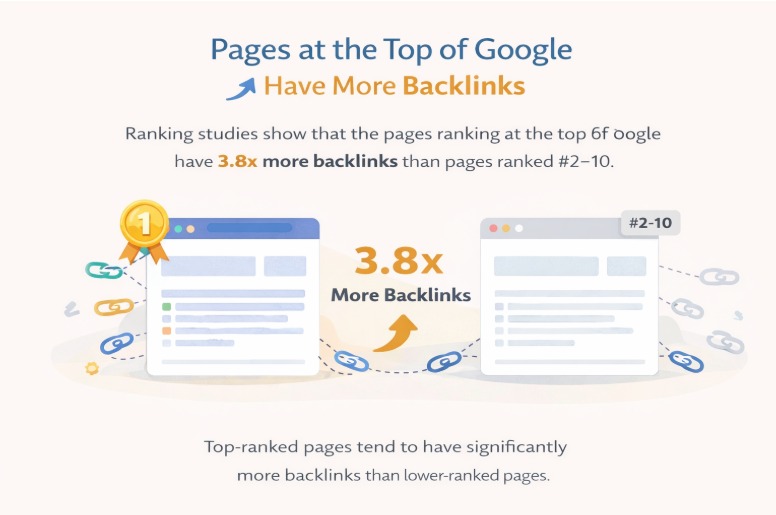
This proves that a strong link profile still plays a huge role in search visibility.
That means backlinks are still one of the strongest SEO signals, but the number you need depends on your niche, your competitors, and the quality of the links you earn.
In this article, I’ll break down how many backlinks I need to rank, in the simplest terms possible — so even beginners can understand and apply it. Keep reading!
Short answer? Yes.
Backlinks still matter in SEO, a lot.
Google has confirmed that links remain one of its top ranking factors. In fact, a study by Backlinko found that the number of domains linking to a page correlates strongly with higher rankings on Google. Pages in position #1 tend to have significantly more backlinks than lower-ranked pages.
Why? Because backlinks act like votes.
When other websites link to you, Google sees that as a signal of trust, authority, and relevance.
That said, not all backlinks are equal.
A few high-quality backlinks from trusted and relevant websites can carry more weight than hundreds of weak ones.
So if you’re wondering whether backlinks still matter in SEO, they absolutely do.
The real question is not if they matter.
It’s how many and what kind you actually need to rank.
To understand how many backlinks you need to rank, you first need to understand how backlinks improve SEO.
Think of backlinks as trust signals.
When a website links to your page, it tells Google, “This content is useful.”
The more relevant backlinks you earn, the more authority your page builds in the eyes of search engines.
Backlinks improve SEO in three simple ways:
But remember, Google doesn’t just count links.
It evaluates them.
That’s why high-quality backlinks from trusted and relevant websites are considered more powerful backlinks than random links from unrelated sites.
So backlinks don’t just improve rankings by number.
They improve rankings through trust, relevance, and authority.
If you’re looking for a fixed number, here’s the truth: there isn’t one.
There’s no universal answer to how many backlinks I need to rank. It depends on your niche, your competition, and the keyword difficulty.
Some low-competition keywords may rank with just a few relevant backlinks.
Highly competitive keywords may require dozens, sometimes hundreds, of powerful backlinks.
That’s why backlinks for beginners shouldn’t be about chasing a number.
They should be about understanding competition and building quality links strategically.
This is where most beginners get confused.
Should you focus on getting as many backlinks as possible?
Or should you aim for fewer, high-quality backlinks?
In quality vs quantity backlinks SEO, quality wins almost every time.
One relevant backlink from an authoritative website in your niche can be more powerful than 50 random links from low-quality directories. Google looks at relevance, authority, and trust — not just numbers.
That’s why relevant backlinks matter more than bulk links.
Powerful backlinks send stronger ranking signals.
So instead of asking, “How many backlinks do I need to rank?”
Start asking, “Are these backlinks actually helping my SEO?”
Now we’re getting closer to the real answer.
The number of high-quality backlinks you need depends on who you’re competing against.
If the top-ranking pages for your keyword have 20–30 relevant backlinks, you’ll likely need something in that range, or better, to compete.
If they have hundreds of powerful backlinks, you’ll need a stronger link-building strategy.
The easiest way to estimate this is simple:
Check the backlink profiles of the top 3–5 results in Google.
Your goal isn’t to guess a number.
It’s to match and slightly outperform the competition with better, more relevant backlinks.
A smart link-building strategy is not about collecting links like trophies.
It’s about earning powerful backlinks that actually move rankings.
Powerful backlinks usually have three things:
Instead of building 100 weak links, focus on getting a few high-quality backlinks from websites that matter in your industry.
That approach is safer, more sustainable, and far more effective for long-term SEO.
Because in the end, it’s not the volume of backlinks that wins.
It’s the strength and relevance behind them.
If you want to know how many backlinks you need, you first need to see what you already have.
To find backlinks to your website, you can use tools like Ahrefs, SEMrush, Moz, or even Google Search Console. These tools show your backlink profile, referring domains, anchor text, and link quality.
But don’t stop there.
You should also check your competitors.
Look at the top-ranking pages for your target keyword and analyze their backlinks.
See where their relevant backlinks are coming from.
Identify patterns. Guest posts? Directories? Resource pages?
This gives you a realistic benchmark.
Instead of guessing how many backlinks you need to rank, you base your strategy on real data.
Here’s the honest answer.
You need enough backlinks to compete with the top-ranking pages for your keyword.
There is no fixed number.
There is no universal rule.
If your competitors have 15 strong, relevant backlinks, that might be enough.
If they have 200 powerful backlinks, you’ll need a stronger link-building strategy.
What matters most is this:
So instead of chasing random numbers, focus on building better links than your competitors.
That’s the real answer to how many backlinks do I need to rank.